Eastern Chalukyas, Pallavas, Cholas and Gangas
What to remember
- Eastern (Vengi) Chalukyas: founder Kubja Vishnuvardhana, capital Vengi. Pallavas: capital Kanchipuram. Western Gangas: capital Talakadu. Early Cholas: capital Uraiyur.
- Pallava line to remember: Simhavishnu, Mahendravarman I, Narasimhavarman I. Pulakeshin II of Badami (capital Vatapi) is the great Chalukya rival, titled Dakshinapatheshwara.
- Capitals, founders and titles are the favourite exam items. Keep one master table for them.
Why these dynasties matter
After the early Andhra dynasties, Andhra and the neighbouring Deccan were ruled by several powers. Their borders touched each other, so their kings fought many wars. Exam questions usually ask four things: who founded the dynasty, where was its capital, who was the greatest king, and which title he carried. This chapter gives you those in one place.
Master table of capitals
| Dynasty | Capital |
|---|---|
| Chalukyas of Vengi (Eastern Chalukyas) | Vengi |
| Pallavas | Kanchipuram |
| Chalukyas of Badami | Vatapi |
| Early Cholas | Uraiyur |
| Western Gangas | Talakadu |
| Salankayanas | Vengi |
| Kadambas | Banavasi |
| Pandyas | Madurai |
| Cheras | Vanji |
| Satavahanas | Pratishthana |
| Anandagotrikas | Kandarapura |
| Brihatpalayanas | Kudura (also spelt Kodur) |
Vengi is shared. First the Salankayanas ruled from there. Later the Eastern Chalukyas made it their capital. Do not give one answer for both without reading the question.
Eastern (Vengi) Chalukyas
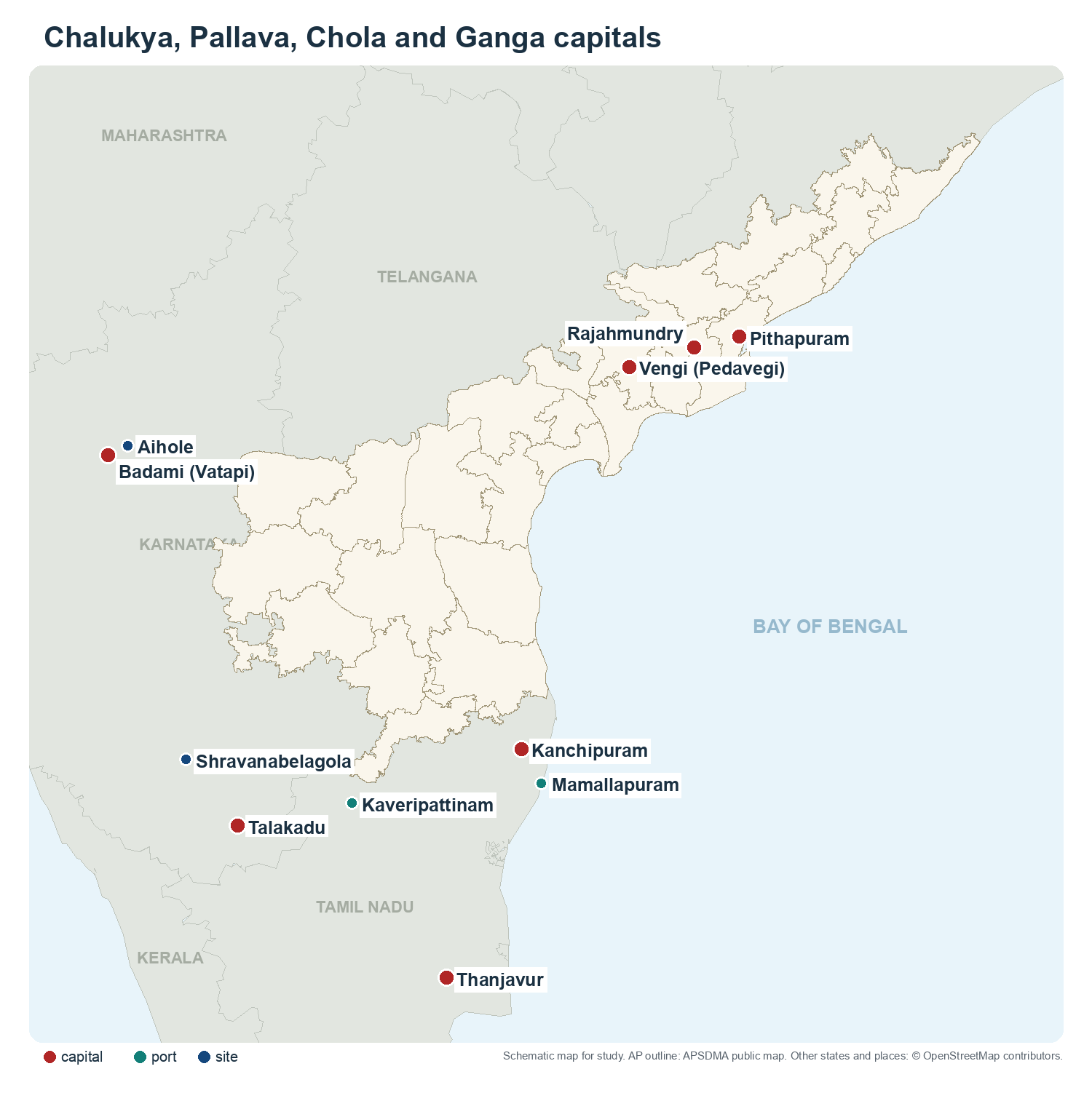
The founder was Kubja Vishnuvardhana. The family sprang from the Chalukyas of Badami, and Kubja Vishnuvardhana is placed in the same royal house as Pulakeshin II. He ruled the Vengi country, at first from Pishtapura (Pithapuram) and then from Vengi (Pedavegi, near Eluru); Rajaraja Narendra later held court at Rajamahendravaram. For a one-word capital answer, Vengi is accepted. The dynasty is called Eastern Chalukyas because it ruled the eastern Deccan, while the main branch ruled from Vatapi in the west.
Pulakeshin II is the best-known Chalukya of Badami. He held the title Dakshinapatheshwara, meaning lord of the southern region. His father was Kirtivarman I.
Pallavas
The Pallava capital was Kanchipuram. Three names are asked again and again:
- 1. Simhavishnu
- 2. Mahendravarman I (son of Simhavishnu)
- 3. Narasimhavarman I (son of Mahendravarman I)
So the order of father and son is Simhavishnu, Mahendravarman I, Narasimhavarman I. Pallavas fought the Chalukyas of Badami for many years, and Pulakeshin II fought on the other side.
Cholas and Gangas
The early Cholas ruled from Uraiyur. The later Chola line, which began with Vijayalaya Chola, ruled from Thanjavur. These are two different Chola capitals in two different phases.
The Western Gangas ruled from Talakadu. They are a Karnataka-based line. Do not confuse them with the Eastern Gangas of Kalinga, who are a separate dynasty.
Titles, eras and royal epithets
| Ruler / item | Title or date |
|---|---|
| Pulakeshin II | Dakshinapatheshwara |
| Gautamiputra Satakarni | Trisamudratoyapitavahana |
| Samudragupta | Napoleon of India |
| Chandragupta II | Vikramaditya |
| Ashoka | Devanampiya Piyadassi |
| Krishnadevaraya | Andhra Bhoja |
| Saka era begins | 78 |
| Gupta era begins | 319 |
Giving these side by side helps you avoid swapping them. For example Napoleon of India belongs to Samudragupta and Vikramaditya to his son Chandragupta II.
Related powers that appear in comparison questions
| Dynasty | Founder | Capital |
|---|---|---|
| Mauryan Empire | Chandragupta Maurya | Pataliputra |
| Shunga | Pushyamitra Shunga | Pataliputra |
| Kanva | Vasudeva Kanva | (not given) |
| Gupta | Sri Gupta | Pataliputra |
| Kushana | Kujula Kadphises | Purushapura |
| Western Kshatrapas | (not given; Chashtana and Rudradaman are rulers) | Ujjain |
| Nanda | Mahapadma Nanda | (not given) |
| Haryanka | Bimbisara | (not given) |
Kanishka belongs to the Kushanas. Kharavela belongs to the Mahameghavahana dynasty and issued the Hathigumpha inscription at Bhubaneswar. Rudradaman of the Western Kshatrapas issued the Girnar inscription at Junagadh.
Succession lists
| Line | Order |
|---|---|
| Mauryas | Chandragupta Maurya, Bindusara, Ashoka, then Dasharatha |
| Guptas | Chandragupta I, Samudragupta, Chandragupta II, Kumaragupta I, Skandagupta |
| Haryanka | Bimbisara, Ajatashatru, Udayin |
| Kushanas | Kanishka, then Huvishka |
| Shungas | Pushyamitra Shunga, then Agnimitra |
Remember father and son pairs: Ashoka was the son of Bindusara, and Bindusara was the son of Chandragupta Maurya. Samudragupta was the son of Chandragupta I, and Chandragupta II was the son of Samudragupta.
Buddhist councils
| Council | Venue | President |
|---|---|---|
| First | Rajagriha | Mahakassapa |
| Second | Vaishali | Sabakami |
| Third | Pataliputra | Moggaliputta Tissa |
| Fourth | Kundalavana | Vasumitra |
Tripitaka is in the Pali language. Ashokan edicts are in Prakrit.
Literature and art
| Item | Link |
|---|---|
| Gatha Saptashati | Hala, Prakrit |
| Brihatkatha | Gunadhya, Paisachi |
| Katantra Vyakarana | Sarvavarman, Sanskrit |
| Arthashastra | Kautilya |
| Buddhacharita | Ashvaghosha |
| Mahabhashya | Patanjali |
| Indica | Megasthenes |
| Mudrarakshasa | Vishakhadatta |
| Suhrllekha, Mulamadhyamakakarika | Nagarjuna (Madhyamika school) |
Amaravati school of art belongs to the Krishna valley. Gandhara school belongs to the Peshawar valley. Mathura school belongs to Mathura.
Sites and where they are
- Amaravati, Dharanikota, Bhattiprolu and Nagarjunakonda: Guntur region.
- Ghantasala and Jaggayyapeta: Krishna region.
- Salihundam: Srikakulam. Bavikonda, Thotlakonda and Sankaram: Visakhapatnam. Ramatirtham: Vizianagaram.
- Kotilingala and Dhulikatta: Karimnagar. Myakadoni inscription: Kurnool.
- Pratishthana, Nanaghat, Karla and Kanheri Caves: Maharashtra. Jogalthembi hoard: Nashik. Sanchi Stupa: Madhya Pradesh. Chandravalli: Chitradurga.
How to answer matching questions
Matching questions in State exams usually give four dynasties and four capitals. Use these steps.
- 1. First match the capital you are sure of. Kanchipuram is Pallava. Talakadu is Western Ganga. Uraiyur is Early Chola. Vatapi is Badami Chalukya.
- 2. Then see which dynasty is left. If the left-over is Chalukyas of Vengi, the answer is Vengi.
- 3. For founders, keep one line: Kubja Vishnuvardhana founded the Chalukyas of Vengi; Chandragupta Maurya founded the Mauryas; Sri Gupta founded the Guptas; Kujula Kadphises founded the Kushanas.
- 4. For rulers of the same house, check the generation. Pulakeshin II belongs to the Badami line, and his father was Kirtivarman I.
Many wrong answers come from a quick guess between Vengi and Vatapi. Read the dynasty name twice before marking.
Exam traps
- Vengi was the capital of two dynasties, the Salankayanas and the Eastern Chalukyas.
- Vatapi (Badami Chalukyas) and Vengi (Eastern Chalukyas) are different capitals of the same family tree.
- Early Cholas used Uraiyur; Vijayalaya's line used Thanjavur.
- Western Gangas (Talakadu) are not the Eastern Gangas of Kalinga.
- Napoleon of India is Samudragupta; Vikramaditya is Chandragupta II.
- Mahendravarman I came after Simhavishnu and before Narasimhavarman I.
- Saka era 78 and Gupta era 319 are different dates; do not exchange them.
- Krishnadevaraya is Andhra Bhoja, not Pulakeshin II.
One-liners
- 1. Founder of the Eastern Chalukyas: Kubja Vishnuvardhana.
- 2. Pallava capital: Kanchipuram.
- 3. Badami Chalukya capital: Vatapi.
- 4. Early Chola capital: Uraiyur.
- 5. Western Ganga capital: Talakadu.
- 6. Pulakeshin II was Dakshinapatheshwara.
- 7. Pallava order: Simhavishnu, Mahendravarman I, Narasimhavarman I.
- 8. Saka era starts in 78.
- 9. Gupta era starts in 319.
- 10. Third Buddhist Council was held at Pataliputra under Moggaliputta Tissa.
Background and context
By the fifth and sixth centuries the Deccan and the far south had no single ruler. The old Andhra families had faded. New powers grew up in four regions at the same time: the Chalukyas in the western Deccan, the Pallavas around Kanchipuram, the Gangas in southern Karnataka, and the Cholas in the Kaveri delta. Their lands touched each other, and the rich lower Krishna-Godavari country, with its port towns and fertile delta, lay between them. This is why the Andhra coast, and especially the Vengi region, was fought over for centuries.
In this chapter the question is not "who won one battle". The question is how four neighbouring families shaped Andhra: through war, through marriage, through temples and through language. Learn the capitals and founders from the tables, and learn the causes from the story below.
Political history
The Chalukyas of Badami and Pulakeshin II. The main Chalukya family ruled from Vatapi (Badami). Their greatest king was Pulakeshin II, who ruled from about 609 to 642 CE. He stopped the northern emperor Harshavardhana at about 618-619 CE. A Chinese pilgrim's report confirms that the people of the Chalukya country did not accept Harsha as their lord. Pulakeshin also kept friendly contact with the Persian king, and exchanged letters and gifts with him around 625. The title Dakshinapatheshwara, lord of the southern region, belongs to him. His court poet Ravikirti wrote the Aihole inscription, which records his deeds on a Jain temple. Pulakeshin was a worshipper of Vishnu, yet he supported Jain and Buddhist communities too.
How Vengi came into the Chalukya family. Pulakeshin II turned east. He defeated the Vishnukundin rulers, who then held the Andhra delta, and took Vengi around 624. He did not rule it himself. He made his younger brother Vishnuvardhana, nicknamed Kubja, the governor of the new land. After some years Kubja Vishnuvardhana made himself an independent king. He is the founder of the line we call the Eastern Chalukyas. His rule is usually given as 624 to 641. Later reports say his kingdom reached Srikakulam in the north and Nellore in the south. The first seat of the family was at Pitapuram (Pishtapura). Later the court was at Vengi, and in the eleventh century it was at Rajamahendravaram (Rajahmundry). Many books simply call the family "Chalukyas of Vengi".
The Pallava rivals. The Pallava king Simhavishnu defeated the Kalabhras and made Kanchi a strong capital in the later sixth century. His son Mahendravarman I came next, and his son Narasimhavarman I followed. Mahendravarman is given c. 600-630 CE in the usual scheme, and Narasimhavarman I c. 630-668. The Pallavas and the Chalukyas of Badami became enemies, partly because both wanted the east coast. The Aihole poet says Pulakeshin pushed a Pallava king back behind the walls of Kanchi. The Pallava records, in turn, claim a victory at Pullalur. Scholars do not agree on how decisive that battle was. What we know is that Narasimhavarman I later took Vatapi, c. 642-643 CE, and Pulakeshin II was probably killed in these wars. Narasimhavarman's title Mamalla gave its name to Mamallapuram.
Eastern Chalukyas after the founder. Kubja Vishnuvardhana's son Jayasimha I ruled c. 641-673. Over the next centuries the kingdom faced pressure from the Rashtrakutas, the Pallavas and the Western Chalukyas. Vijayaditya III (c. 849-892) is remembered as a king who steadied the realm against Rashtrakuta power. The family also made marriage links with the Cholas. In the eleventh century Rajaraja Narendra (c. 1019-1061) ruled, and he was a great patron of letters. The line drew close to the Cholas, and one account says that after 1070 Vengi was governed as a Chola province under a prince of the joint family. Other books say that the line of Eastern Chalukya kings continued to c. 1189, with the Kakatiyas, once vassals of the Western Chalukyas, taking over later. Because the books differ, a safe statement is "the Eastern Chalukya line declined in the later eleventh and twelfth centuries and the Kakatiyas rose in the same land".
Pallava rise and fall. The Pallavas are given the period c. 275-897 CE as a whole. Scholars still debate whether they began as officers of the Satavahanas in Andhra or were local rulers of the Kanchi region. After Narasimhavarman I, Narasimhavarman II built the Shore Temple. Nandivarman II (c. 731-795) held power in the eighth century. The Chola king Aditya I defeated the last Pallava king around 897.
Early Cholas. The first Cholas ruled from Uraiyur, near today's Tiruchirappalli, and from the port of Kaveripattinam. They belong to the Sangam age. Karikala is their best known king. He is credited with the Grand Anicut (Kallanai) on the Kaveri and with winning over a union of enemies. After the early period there was a long gap of several centuries, when the Kalabhras and others held the Tamil country. Then Vijayalaya Chola revived the family around 850 and began the line that ruled from Thanjavur. For Andhra, this later Chola line matters most, because it married into the Eastern Chalukya house.
Western Gangas. Do not confuse this family with the Eastern Gangas of Kalinga. The Western Gangas held much of southern Karnataka from about 350 to 1004 CE, and their rule closed with the Chola conquest of Gangavadi, about 1000. Their start lay in Pallava weakness, which let local clans claim freedom. Two kings are worth remembering. Durvinita (529-579) was a scholar-king, credited with a Sanskrit version of the Brihatkatha and a commentary on Bharavi's Kiratarjuniya. Shivamara I (679-726) is known for his many Jain temples. The court sat first at Kolar, then at Talakadu on the Kaveri, and later in other towns.
Administration and economy
The Eastern Chalukya state was a monarchy with a council of high officers. Texts speak of eighteen offices, called *tirthas*, among them a minister, a chaplain and a commander. Their lands lay between the Krishna and the Godavari, and the dynasty held coastal places, so the sea was open to them.
The Pallavas had a strong royal court at Kanchi. Their port Mamallapuram sent goods and ideas by sea. The Western Gangas used Sanskrit and Kannada in their records, and over time Kannada became the main language. Ministers, treasurers and local officials formed their ladder of government. The Early Cholas gained from the Kaveri water works and from trade between the delta and the sea.
In all these states, grants of land to temples and Brahmins were an important tool. A king gave a village, wrote the gift on copper plates and thus linked his name with a shrine.
Society, religion and culture
Eastern Chalukyas. Hinduism was the main faith. Shaivism was more popular than Vaishnavism, and kings built and endowed temples. Buddhism faded in the region while Jainism kept support. The great cultural event is the work of Nannaya, poet at the court of Rajaraja Narendra. He began the Telugu Mahabharata in the eleventh century. This is the starting point of written Telugu literature as books are usually taught. Rajahmundry thus became a city of letters.
Pallavas. Mahendravarman I wrote a Sanskrit comic play, *Mattavilasa Prahasana*. He first favoured Jainism and later turned to Shaivism. The Pallavas started rock-cut temple building in the Tamil country, and the rock-cut and monolithic temples of Mamallapuram carry the style to its height. The Shore Temple and the Kailasanatha temple of Kanchi are later stone temples. The Chinese traveller Xuanzang saw many Buddhist monasteries and Hindu temples at Kanchi. The Alvars and Nayanars, the Vaishnava and Shaiva saints, belong to this age. The Pallava script helped shape later scripts of the south, including the Grantha and Tamil letters.
Western Gangas. They gave kindly treatment to all faiths, but they were great patrons of Jainism. The monuments at Shravanabelagola and Kambadahalli are linked with them. Chavundaraya, a minister and commander, wrote an important Kannada prose work in 978.
Early Cholas. Their literature is the Tamil Sangam poetry, which describes kings, war and trade.
Why Vengi was fought over: a chain of causes
- 1. Position. Vengi lay on the east coast, between the Chalukya lands of the west and the Pallava lands of the south. Whoever held it could threaten both.
- 2. Conquest by Pulakeshin II. After he took the area from the Vishnukundins, he put his brother there. This made the coast a Chalukya outpost far from Vatapi.
- 3. Pallava reaction. The struggle for Vengi between the Pallavas and the Chalukyas was one of the causes of a long war, which at first went against the Pallavas and later against Pulakeshin.
- 4. Independence. Far from Vatapi, the governor became a king. The Eastern Chalukya line then grew into a local state of Andhra.
- 5. Chola entry. On the east coast the Cholas fought the Chalukyas for Vengi. Marriage links between the two houses followed, and in the end Vengi was run as a Chola province under a prince of the joint family, in the account of one source.
What Mamallapuram shows
Begin with the name. Mamallapuram comes from Mamalla, the title of Narasimhavarman I (c. 630-668), and it was a busy Pallava port on the Coromandel coast. The craftsmen worked in the natural rock itself. Work began in the time of Mahendravarman I (c. 600-630), and richer rock carving came in under Narasimhavarman I. This is why questions link Mahendravarman with the start of rock-cut work and Narasimhavarman with its richer form. Four kinds of monument stand there: a huge open-air carved scene called the Descent of the Ganges, cave temples, chariot-shaped monolithic temples (rathas), and a structural temple by the shore.
A simple timeline to carry
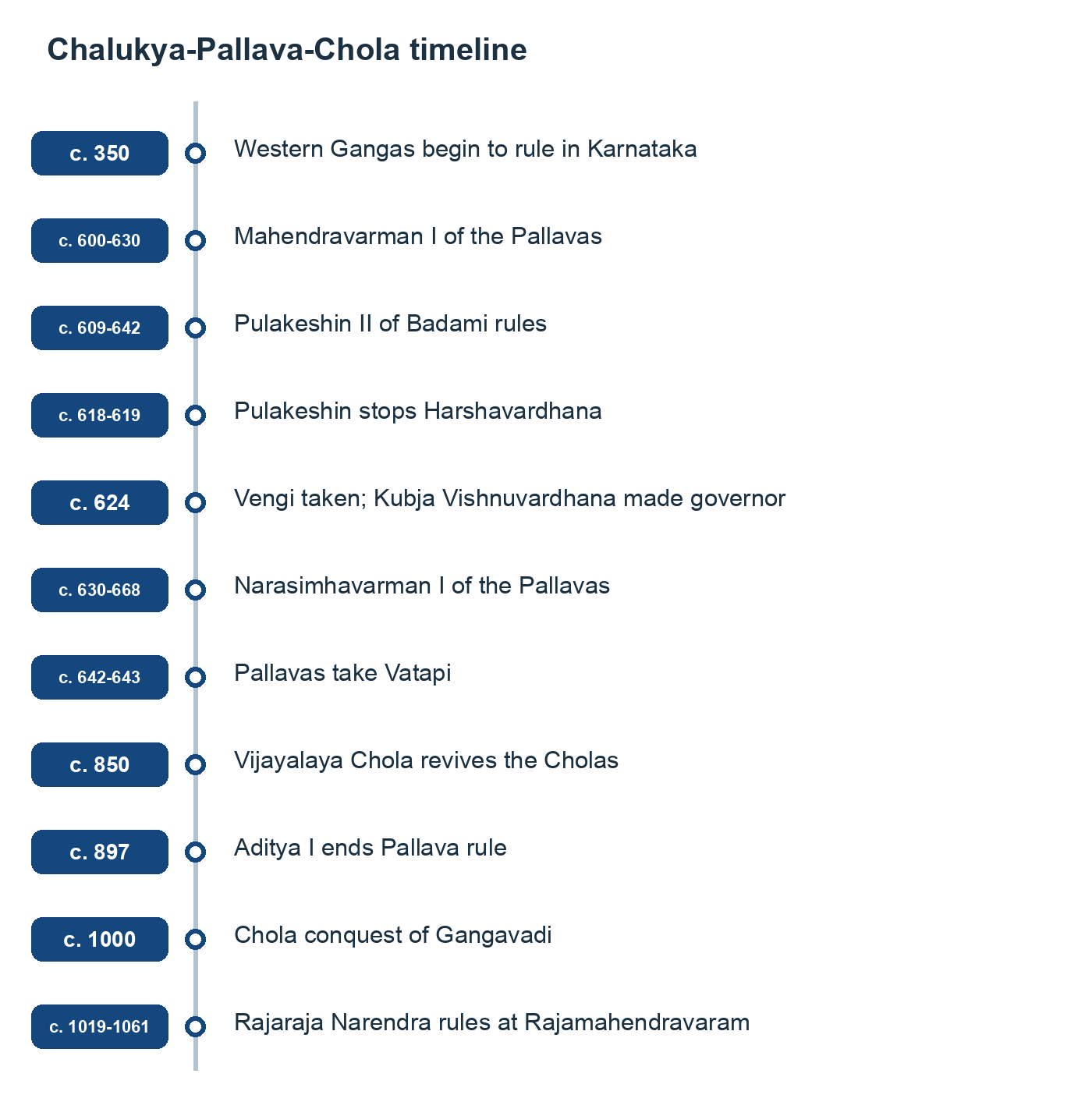
| Approximate years (CE) | Event |
|---|---|
| c. 350 | Western Gangas begin to rule in Karnataka |
| c. 575-600 | Simhavishnu of the Pallavas |
| c. 600-630 | Mahendravarman I |
| c. 609-642 | Pulakeshin II |
| c. 618-619 | Pulakeshin stops Harsha |
| c. 624 | Vengi taken; Kubja Vishnuvardhana governor, later king |
| c. 630-668 | Narasimhavarman I |
| c. 642-643 | Vatapi taken by the Pallavas |
| c. 850 | Vijayalaya Chola revives the Cholas |
| c. 897 | Aditya I ends Pallava rule |
| c. 1000 | Chola conquest of Gangavadi |
| c. 1019-1061 | Rajaraja Narendra |
All years are approximate. Some books vary by a few years for each king.
Common mistakes
- Mixing Chalukya branches. The Badami branch ruled from Vatapi in the west. The Eastern branch started when Pulakeshin II appointed his brother at Vengi. Both belong to one family, and the capitals are different.
- Reversing the Pallava generations. Mahendravarman I is the father of Narasimhavarman I, not the other way.
- Thinking Vengi had one ruling family. Vengi was also the Salankayana seat. Do not give one answer for both periods.
- Giving the Early Chola capital as Thanjavur. Uraiyur is the early capital. Thanjavur is for the line begun by Vijayalaya.
- Treating Telugu literature as starting with the Kakatiyas. Nannaya's work belongs to the court of the Eastern Chalukya king Rajaraja Narendra.
- Taking Chola power as ending Eastern Chalukya rule at one stroke. The change was slow and went through marriage, as the sources describe it.
Decline, legacy and sites to know
The long struggle ended by absorption. The Pallavas fell to the Cholas c. 897. The Western Gangas lost to the Cholas c. 1000. The Eastern Chalukyas joined the Chola world by marriage and then lost their separate place. Their gift to Andhra was lasting: Vengi as a name, early Telugu writing, and a style of temple building along the Godavari.
| Dynasty | Founder or key king | Capital | Note |
|---|---|---|---|
| Eastern Chalukyas | Kubja Vishnuvardhana | Pitapuram, then Vengi, then Rajamahendravaram | Telugu literary start under Rajaraja Narendra |
| Chalukyas of Badami | Pulakeshin II (greatest king) | Vatapi | Dakshinapatheshwara |
| Pallavas | Simhavishnu, Mahendravarman I, Narasimhavarman I | Kanchipuram | Mamallapuram |
| Early Cholas | Karikala | Uraiyur, also Kaveripattinam | Kallanai |
| Western Gangas | Durvinita among the early kings | Kolar, then Talakadu | Jain patronage |
Sites to know: Pedavegi near Eluru (Vengi); Pitapuram; Rajahmundry; Kanchipuram; Mamallapuram, which is listed as a World Heritage site; Vatapi (Badami); Talakadu; Shravanabelagola; Uraiyur; Kaveripattinam.
How examiners use this chapter
- Capital pairs: Vengi (Eastern Chalukyas), Vatapi (Badami Chalukyas), Kanchipuram (Pallavas), Uraiyur (Early Cholas), Talakadu (Western Gangas).
- Vengi is also the Salankayana capital, so read the dynasty name in the question.
- Pallava order: Simhavishnu, Mahendravarman I, Narasimhavarman I.
- Title: Pulakeshin II is Dakshinapatheshwara. Do not give it to another king.
- Kubja Vishnuvardhana was the younger brother of Pulakeshin II and the founder of the Eastern Chalukyas.
- Nannaya, Rajaraja Narendra and the Telugu Mahabharata form one chain.
- Mahendravarman I wrote *Mattavilasa Prahasana*. Narasimhavarman I is the one linked with the capture of Vatapi and with Mamallapuram.
- Western Gangas of Karnataka are not the Eastern Gangas of Kalinga; early Cholas of Uraiyur are not the Thanjavur Cholas.
- Harsha and Pulakeshin II: the northern emperor was stopped in the Chalukya country, c. 618-619.
- Xuanzang visited Kanchi; Aihole inscription was written by Ravikirti; both are small facts that often appear as pair questions.
- Karikala and the Kallanai (Grand Anicut) form the one-line link for the Early Cholas.
Worked cases
Case 1: Match the dynasty with its capital. (A) Pallavas (B) Western Gangas (C) Early Cholas (D) Chalukyas of Badami. Capitals: 1 Uraiyur, 2 Vatapi, 3 Talakadu, 4 Kanchipuram.
Reasoning:
- 1. Pick the pair you are sure of. Kanchipuram is the Pallava capital, so A matches 4.
- 2. Talakadu is the capital of the Western Gangas, a Karnataka-based line. So B matches 3.
- 3. Uraiyur belongs to the early Cholas. So C matches 1.
- 4. What is left is Vatapi. The Chalukyas of Badami ruled from Vatapi, so D matches 2.
Takeaway: Fill the sure pairs first. The last pair then needs no guess.
Case 2: "Vengi was the capital of which dynasties?" Options: (1) Only the Eastern Chalukyas (2) Only the Salankayanas (3) Salankayanas and Eastern Chalukyas (4) Badami Chalukyas.
Reasoning:
- 1. The Salankayanas ruled from Vengi. This is the early period.
- 2. The Eastern Chalukyas, founded by Kubja Vishnuvardhana, also ruled from Vengi. This is the later period.
- 3. The Badami Chalukyas ruled from Vatapi, not Vengi. So option 4 is out.
- 4. Options 1 and 2 are each half true. Only option 3 gives both.
Takeaway: If a place served two dynasties, look for the option that names both.
Case 3: Which statement is NOT correct? (1) Samudragupta was called Napoleon of India (2) Chandragupta II was called Vikramaditya (3) Krishnadevaraya was called Andhra Bhoja (4) Pulakeshin II was called Andhra Bhoja.
Reasoning:
- 1. Samudragupta is Napoleon of India. Option 1 is correct.
- 2. Chandragupta II is Vikramaditya. Option 2 is correct.
- 3. Krishnadevaraya is Andhra Bhoja. Option 3 is correct.
- 4. Pulakeshin II held the title Dakshinapatheshwara. So option 4 is wrong.
Takeaway: Keep one title for one ruler. A title given to the wrong ruler is the usual trap.
Case 4: Arrange in order of the Buddhist councils: Pataliputra, Rajagriha, Kundalavana, Vaishali.
Reasoning:
- 1. The First Council was at Rajagriha under Mahakassapa.
- 2. The Second Council was at Vaishali under Sabakami.
- 3. The Third Council was at Pataliputra under Moggaliputta Tissa.
- 4. The Fourth Council was at Kundalavana under Vasumitra.
Takeaway: Learn venue, president and number as one chain: Rajagriha, Vaishali, Pataliputra, Kundalavana.
Compare and contrast
| Look-alike pair | Item A | Item B |
|---|---|---|
| Vatapi and Vengi | Vatapi: capital of the Chalukyas of Badami (the main western branch) | Vengi: capital of the Eastern Chalukyas, founded by Kubja Vishnuvardhana |
| Western and Eastern Gangas | Western Gangas: Karnataka-based, capital Talakadu | Eastern Gangas: rulers of Kalinga, a separate dynasty |
| Uraiyur and Thanjavur | Uraiyur: capital of the early Cholas | Thanjavur: capital of the line that began with Vijayalaya Chola |
| Saka era and Gupta era | Saka era begins in 78 | Gupta era begins in 319 |
| Ruler | Title or work | Do not confuse with |
|---|---|---|
| Samudragupta | Napoleon of India | Chandragupta II, who is Vikramaditya |
| Pulakeshin II | Dakshinapatheshwara | Krishnadevaraya, who is Andhra Bhoja |
| Ashoka | Devanampiya Piyadassi | Kanishka, a Kushana ruler |
| Kharavela | Hathigumpha inscription at Bhubaneswar | Rudradaman, whose Girnar inscription is at Junagadh |
Memory tip for these pairs. First name the family tree. Badami and Vengi Chalukyas come from one house, but they are two capitals: Vatapi in the west and Vengi in the east. Then name the region. Western Gangas are of Karnataka and rule from Talakadu. Early Cholas rule from Uraiyur. A question that gives only a capital can be solved by this two-step check: family first, region next. Also keep the title list short. One ruler, one title: Napoleon of India, Vikramaditya, Dakshinapatheshwara, Andhra Bhoja.
Sequence and timeline
| Step | Item |
|---|---|
| 1 | Pallava order: Simhavishnu, Mahendravarman I, Narasimhavarman I |
| 2 | Maurya order: Chandragupta Maurya, Bindusara, Ashoka, Dasharatha |
| 3 | Haryanka order: Bimbisara, Ajatashatru, Udayin |
| 4 | Gupta order: Chandragupta I, Samudragupta, Chandragupta II, Kumaragupta I, Skandagupta |
| 5 | Kushana order: Kanishka, then Huvishka |
| 6 | Shunga order: Pushyamitra Shunga, then Agnimitra |
Era dates in order: Saka era begins in 78, then the Gupta era begins in 319.
How to use these orders in the exam. For succession questions, read the chain and check both neighbours of the name asked. For example, in the Pallava chain Mahendravarman I sits between Simhavishnu and Narasimhavarman I, so he can be neither first nor last. In the Gupta chain, Chandragupta II comes after Samudragupta and before Kumaragupta I.
For era questions, remember that 78 is smaller than 319. The Saka era is therefore the earlier starting point. In the Buddhist council chain, the Third Council at Pataliputra is the only one under Moggaliputta Tissa. Link each council with its venue and president so that one clue is enough to find the other two.
More one-liners
- 1. Rudradaman belonged to the Western Kshatrapas, with capital Ujjain.
- 2. Kujula Kadphises founded the Kushana Empire, with capital Purushapura.
- 3. Sri Gupta founded the Gupta Empire.
- 4. Mahapadma Nanda founded the Nanda dynasty.
- 5. Vasudeva Kanva founded the Kanva dynasty.
- 6. Bimbisara founded the Haryanka dynasty.
- 7. Kadambas ruled from Banavasi; Cheras ruled from Vanji.
- 8. Chandravalli is a site in Chitradurga.
- 9. Sanchi Stupa is in Madhya Pradesh.
- 10. Karla Caves and Kanheri Caves are in Maharashtra.
- 11. Jogalthembi hoard was found at Nashik.
- 12. Mudrarakshasa was written by Vishakhadatta.
- 13. Buddhacharita was written by Ashvaghosha.
- 14. Indica was written by Megasthenes.
- 15. Mahabhashya was written by Patanjali.
Practice questions
Match the source with its author or issuer: (1) Gathasaptasati (a) Gunadhya (2) Brihatkatha (b) Hala (3) Nasik prasasti (c) Gautami Balasri (4) Hathigumpha inscription (d) Kharavela
- 1-a, 2-b, 3-c, 4-d
- 1-a, 2-b, 3-d, 4-c
- 1-b, 2-a, 3-c, 4-d
- 1-b, 2-a, 3-d, 4-c
Answer
C. 1-b, 2-a, 3-c, 4-d
Hala is linked with the Gathasaptasati, Gunadhya with the Brihatkatha, Gautami Balasri with the Nasik prasasti and Kharavela with Hathigumpha.
మూలాన్ని దాని రచయిత/వేయించినవారితో జతచేయండి: (1) గాథాసప్తశతి (a) గుణాఢ్యుడు (2) బృహత్కథ (b) హాలుడు (3) నాసిక్ ప్రశస్తి (c) గౌతమీ బాలశ్రీ (4) హాథీగుంఫా శాసనం (d) ఖారవేలుడు
- 1-a, 2-b, 3-c, 4-d
- 1-a, 2-b, 3-d, 4-c
- 1-b, 2-a, 3-c, 4-d
- 1-b, 2-a, 3-d, 4-c
The Sanskrit rock inscription at Junagadh (Girnar) records the achievements of which Western Kshatrapa ruler?
- Chashtana
- Nahapana
- Jayadaman
- Rudradaman I
Answer
D. Rudradaman I
The Junagadh inscription is of Rudradaman I, a rival of the Satavahanas.
జునాగఢ్ (గిర్నార్) వద్దనున్న సంస్కృత శిలా శాసనం ఏ పశ్చిమ క్షత్రప పాలకుని విజయాలను తెలుపుతుంది?
- చష్టనుడు
- నహపానుడు
- జయదాముడు
- మొదటి రుద్రదాముడు
Consider the statements: (i) Gautamiputra Satakarni defeated Nahapana. (ii) His mother Gautami Balasri issued the Nasik inscription. (iii) Simuka was the last Satavahana king. Which of the statements is/are correct?
- Only (i)
- Only (iii)
- (i) and (ii)
- (ii) and (iii)
Answer
C. (i) and (ii)
Simuka was the founder, not the last king, so (iii) is wrong.
ఈ క్రింది ప్రకటనలను పరిశీలించండి: (i) గౌతమీపుత్ర శాతకర్ణి నహపానుడిని ఓడించాడు. (ii) అతని తల్లి గౌతమీ బాలశ్రీ నాసిక్ శాసనాన్ని వేయించింది. (iii) సిముఖుడు చివరి శాతవాహన రాజు. ఏ ప్రకటన/ప్రకటనలు సరైనవి?
- (i) మాత్రమే
- (iii) మాత్రమే
- (i), (ii)
- (ii), (iii)
Which Chalukya ruler of Badami conquered the Vengi region around the early 7th century CE, ending Vishnukundina power in coastal Andhra?
- Pulumavi
- Kirtivarman II
- Vikramaditya I
- Pulakeshin II
Answer
D. Pulakeshin II
Pulakeshin II took Vengi and put his brother Kubja Vishnuvardhana in charge.
క్రీ.శ. 7వ శతాబ్ది ప్రారంభంలో వేంగి ప్రాంతాన్ని జయించి కోస్తాంధ్రలో విష్ణుకుండినుల ఆధిపత్యాన్ని అంతం చేసిన బాదామి చాళుక్య రాజు ఎవరు?
- పులుమావి
- రెండవ కీర్తివర్మ
- మొదటి విక్రమాదిత్యుడు
- రెండవ పులకేశి
Which Satavahana ruler destroyed the Kshaharata line of Nahapana and restruck his silver coins?
- Gautamiputra Satakarni
- Hala
- Vasishthiputra Pulumavi
- Yajna Sri Satakarni
Answer
A. Gautamiputra Satakarni
Overstruck Nahapana coins mark Gautamiputra's victory.
క్షహరాట వంశానికి చెందిన నహపానుని నాశనం చేసి అతని వెండి నాణేలను తిరిగి ముద్రించిన శాతవాహన రాజు ఎవరు?
- గౌతమీపుత్ర శాతకర్ణి
- హాలుడు
- వాసిష్ఠీపుత్ర పులోమావి
- యజ్ఞశ్రీ శాతకర్ణి
Which Satavahana ruler defeated the Kshaharata king Nahapana and re-struck his silver coins with his own insignia?
- Simuka
- Satakarni I
- Gautamiputra Satakarni
- Yajna Sri Satakarni
Answer
C. Gautamiputra Satakarni
Gautamiputra Satakarni's victory over Nahapana is recorded in the Nashik inscription issued by his mother.
క్షహరాట రాజు నహపానుని ఓడించి అతని వెండి నాణేలను తన ముద్రతో తిరిగి ముద్రించిన శాతవాహన రాజు ఎవరు?
- సిముకుడు
- మొదటి శాతకర్ణి
- గౌతమీపుత్ర శాతకర్ణి
- యజ్ఞశ్రీ శాతకర్ణి
Who was the first king of the Satavahana dynasty?
- Pushyamitra Shunga
- Musunuri Prolaya Nayaka
- Vasishthiputra Chantamula
- Simuka
Answer
D. Simuka
శాతవాహన వంశ మొదటి రాజు ఎవరు?
- పుష్యమిత్ర శుంగుడు
- ముసునూరి ప్రోలయ నాయకుడు
- వాశిష్ఠీపుత్ర చాంతమూలుడు
- సిముకుడు
Match the ruler with the association: (1) Simuka (2) Hala (3) Gautamiputra Satakarni (4) Yajna Sri Satakarni (a) Gathasaptashati (b) Founder of the dynasty (c) Defeated Nahapana (d) Ship-type coins
- 1-b, 2-c, 3-a, 4-d
- 1-b, 2-a, 3-c, 4-d
- 1-a, 2-b, 3-c, 4-d
- 1-c, 2-a, 3-b, 4-d
Answer
B. 1-b, 2-a, 3-c, 4-d
Simuka founded the line, Hala compiled the verses, Gautamiputra beat Nahapana and Yajna Sri issued ship coins.
పాలకులను వారి విశేషాలతో జతపరచండి: (1) సిముఖుడు (2) హాలుడు (3) గౌతమీపుత్ర శాతకర్ణి (4) యజ్ఞశ్రీ శాతకర్ణి (a) గాథాసప్తశతి (b) వంశ స్థాపకుడు (c) నహపానుని ఓడించినవాడు (d) ఓడ చిహ్న నాణేలు
- 1-b, 2-c, 3-a, 4-d
- 1-b, 2-a, 3-c, 4-d
- 1-a, 2-b, 3-c, 4-d
- 1-c, 2-a, 3-b, 4-d
Virapurushadatta of the Ikshvaku dynasty had a matrimonial alliance with the family of which dynasty of Ujjain?
- Pallava
- Kadamba
- Saka (Western Kshatrapa)
- Gupta
Answer
C. Saka (Western Kshatrapa)
He married a princess of the Saka Mahakshatrapa family of Ujjain.
ఇక్ష్వాకు వంశానికి చెందిన వీరపురుషదత్తునికి ఉజ్జయిని లోని ఏ వంశంతో వివాహ సంబంధం ఉంది?
- పల్లవ
- కదంబ
- శక (పశ్చిమ క్షత్రప)
- గుప్త
Which was the first Satavahana inscription in Andhra?
- Myakadoni inscription
- Amaravati inscription
- Nasik inscription
- Bhattiprolu
Answer
B. Amaravati inscription
Amaravati.
ఆంధ్ర ప్రాంతంలో వేయించిన మొదటి శాతవాహన శాసనం ఏది?
- మ్యాకదోని శాసనం
- అమరావతి శాసనం
- నాసిక్ శాసనం
- భట్టిప్రోలు
Which was the first inscription issued in Andhra region?
- Amaravati inscription
- Nasik inscription
- Junagadh inscription
- Hathigumpha inscription
Answer
A. Amaravati inscription
Amaravati inscription is correct per the page.
ఆంధ్ర ప్రాంతంలో వేయబడిన మొదటి శాసనం ఏది?
- అమరావతి శాసనం
- నాసిక్ శాసనం
- జునాఘడ్ శాసనం
- హాథీగుంఫా శాసనం
Gautamiputra Satakarni is remembered for destroying the power of which Kshaharata (Western Kshatrapa) ruler?
- Rudradaman I
- Nahapana
- Kanishka
- Demetrius
Answer
B. Nahapana
Gautamiputra Satakarni overthrew the Kshaharata ruler Nahapana and restored Satavahana prestige in the western Deccan.
గౌతమీపుత్ర శాతకర్ణి ఏ క్షహరాత (పశ్చిమ క్షత్రప) పాలకుని శక్తిని నాశనం చేశాడని ప్రసిద్ధి?
- మొదటి రుద్రదామన్
- నహపానుడు
- కనిష్కుడు
- డెమెట్రియస్
The Hathigumpha inscription at Udayagiri, Odisha, which names a Satakarni, belongs to which ruler?
- Ashoka
- Kharavela
- Rudradaman I
- Samudragupta
Answer
B. Kharavela
Kharavela of Kalinga issued the Hathigumpha record; its mention of Satakarni helps date the early Satavahanas.
ఒడిశాలోని ఉదయగిరిలో ఉన్న హాథీగుంఫా శాసనం, ఒక శాతకర్ణి పేరును పేర్కొంటుంది; ఇది ఏ పాలకునిది?
- అశోకుడు
- ఖారవేలుడు
- మొదటి రుద్రదామన్
- సముద్రగుప్తుడు
Which early dynasty ruling from Vengi in the Godavari and Krishna delta region preceded the Eastern Chalukyas?
- Haihayas of Kona
- Salankayanas
- Qutb Shahis
- Gajapatis
Answer
B. Salankayanas
గోదావరి, కృష్ణా డెల్టా ప్రాంతంలో వేంగి నుండి పాలించి, తూర్పు చాళుక్యులకు పూర్వం ఉన్న తొలి వంశం ఏది?
- కోనకు చెందిన హైహయులు
- శాలంకాయనులు
- కుతుబ్ షాహీలు
- గజపతులు
Which of the following belongs to Sanskrit?
- Brihatkatha
- Nasik Prasasti
- Suhrllekha
- Ashokan edicts
Answer
C. Suhrllekha
ఈ క్రింది వాటిలో 'సంస్కృతం' వర్గానికి చెందినది ఏది?
- బృహత్కథ
- నాసిక్ ప్రశస్తి
- సుహృల్లేఖ
- అశోకుని శాసనాలు
Which of the following is NOT correctly paired with Prakrit (Item – Category)?
- Gathasaptashati
- Nasik Prasasti
- Brihatkatha
- Hathigumpha inscription
Answer
C. Brihatkatha
ఈ క్రింది వాటిలో ఏది 'ప్రాకృతం' అనే అంశానికి సరిగ్గా జతకాదు? (అంశం – వర్గం)
- గాథాసప్తశతి
- నాసిక్ ప్రశస్తి
- బృహత్కథ
- హాథీగుంఫా శాసనం
Who was the first king of the Ikshvaku dynasty?
- Musunuri Prolaya Nayaka
- Pushyamitra Shunga
- Vasishthiputra Chantamula
- Shishunaga
Answer
C. Vasishthiputra Chantamula
ఇక్ష్వాకు వంశ మొదటి రాజు ఎవరు?
- ముసునూరి ప్రోలయ నాయకుడు
- పుష్యమిత్ర శుంగుడు
- వాశిష్ఠీపుత్ర చాంతమూలుడు
- శిశునాగుడు
Which of the following correctly describes Vasishthiputra Chantamula?
- first Musunuri Nayaka king
- first king of the Ikshvaku dynasty
- first king of the Satavahana dynasty
- first king of the Shunga dynasty
Answer
B. first king of the Ikshvaku dynasty
'వాశిష్ఠీపుత్ర చాంతమూలుడు' గురించిన సరైన వివరణ ఈ క్రింది వాటిలో ఏది?
- ముసునూరి తొలి నాయక రాజు
- ఇక్ష్వాకు వంశ మొదటి రాజు
- శాతవాహన వంశ మొదటి రాజు
- శుంగ వంశ మొదటి రాజు
Which of the following is located in the Kurnool district area?
- Belum Caves
- Myakadoni inscription
- Rajanagaram
- Ghantasala Buddhist stupa
Answer
B. Myakadoni inscription
ఈ క్రింది వాటిలో ఏది కర్నూలు జిల్లా ప్రాంతంలో ఉంది?
- బెలూం గుహలు
- మ్యాకదోని శాసనం
- రాజానగరం
- ఘంటసాల బౌద్ధ స్తూపం
Which of the following is located in the Guntur region area?
- Sankaram
- Kotilingala
- Amaravati Stupa
- Jaggayyapeta
Answer
C. Amaravati Stupa
ఈ క్రింది వాటిలో ఏది గుంటూరు ప్రాంతం ప్రాంతంలో ఉంది?
- శంకరం
- కోటిలింగాల
- అమరావతి స్తూపం
- జగ్గయ్యపేట
In which district or place is Bhattiprolu Stupa located?
- Krishna region
- Kurnool
- Visakhapatnam
- Guntur region
Answer
D. Guntur region
భట్టిప్రోలు స్తూపం ఏ జిల్లా/ప్రాంతంలో ఉంది?
- కృష్ణా ప్రాంతం
- కర్నూలు
- విశాఖపట్నం
- గుంటూరు ప్రాంతం
Which of the following is located in the Krishna region area?
- Myakadoni inscription
- Ghantasala
- Chandravalli
- Kotilingala
Answer
B. Ghantasala
ఈ క్రింది వాటిలో ఏది కృష్ణా ప్రాంతం ప్రాంతంలో ఉంది?
- మ్యాకదోని శాసనం
- ఘంటసాల
- చంద్రవల్లి
- కోటిలింగాల
Which of the following is located in the Visakhapatnam area?
- Amaravati Stupa
- Chandravalli
- Jogalthembi hoard
- Sankaram
Answer
D. Sankaram
ఈ క్రింది వాటిలో ఏది విశాఖపట్నం ప్రాంతంలో ఉంది?
- అమరావతి స్తూపం
- చంద్రవల్లి
- జోగల్థెంబి నిక్షేపం
- శంకరం
In which district or place is Jogalthembi hoard located?
- Krishna region
- Nashik
- Guntur region
- Vizianagaram
Answer
B. Nashik
జోగల్థెంబి నిక్షేపం ఏ జిల్లా/ప్రాంతంలో ఉంది?
- కృష్ణా ప్రాంతం
- నాసిక్
- గుంటూరు ప్రాంతం
- విజయనగరం
Which of the following is located in the Nashik area?
- Myakadoni inscription
- Jogalthembi hoard
- Dhulikatta
- Ramatirtham
Answer
B. Jogalthembi hoard
ఈ క్రింది వాటిలో ఏది నాసిక్ ప్రాంతంలో ఉంది?
- మ్యాకదోని శాసనం
- జోగల్థెంబి నిక్షేపం
- ధూళికట్ట
- రామతీర్థం
Which of the following is NOT correctly paired with Guntur region (Place – Location)?
- Chandravalli
- Amaravati Stupa
- Nagarjunakonda
- Bhattiprolu Stupa
Answer
A. Chandravalli
ఈ క్రింది వాటిలో ఏది 'గుంటూరు ప్రాంతం' అనే అంశానికి సరిగ్గా జతకాదు? (ప్రదేశం – ఉన్న చోటు)
- చంద్రవల్లి
- అమరావతి స్తూపం
- నాగార్జునకొండ
- భట్టిప్రోలు స్తూపం
By which name or title is Gautamiputra Satakarni known?
- Dakshinapatheshwara
- Trisamudratoyapitavahana
- Devanampiya Piyadassi
- Vikramaditya
Answer
B. Trisamudratoyapitavahana
గౌతమీపుత్ర శాతకర్ణి ఏ పేరుతో లేదా బిరుదుతో పిలువబడుతుంది?
- దక్షిణాపథేశ్వరుడు
- త్రిసముద్రతోయపీతవాహనుడు
- దేవానాంప్రియ ప్రియదర్శి
- విక్రమాదిత్యుడు
By which name or title is Pulakeshin II known?
- Dakshinapatheshwara
- Devanampiya Piyadassi
- Napoleon of India
- Vikramaditya
Answer
A. Dakshinapatheshwara
రెండవ పులకేశి ఏ పేరుతో లేదా బిరుదుతో పిలువబడుతుంది?
- దక్షిణాపథేశ్వరుడు
- దేవానాంప్రియ ప్రియదర్శి
- భారతదేశపు నెపోలియన్
- విక్రమాదిత్యుడు
Consider the following pairs (Item – Region): (i) Alluri Sitarama Raju – Vizianagaram (ii) Gurajada Apparao – Visakhapatnam Agency (iii) Ship-type coins of Yajna Sri Satakarni – Chinnaganjam Which of the pairs are correctly matched?
- Only (iii)
- Only (i)
- All of (i), (ii) and (iii)
- Only (ii) and (iii)
Answer
A. Only (iii)
ఈ క్రింది జతలను పరిశీలించండి (అంశం – ప్రాంతం): (i) అల్లూరి సీతారామరాజు – విజయనగరం (ii) గురజాడ అప్పారావు – విశాఖ ఏజెన్సీ (iii) యజ్ఞశ్రీ శాతకర్ణి నౌకా నాణేలు – చినగంజాం సరిగ్గా జతపరచబడినవి ఏవి?
- (iii) మాత్రమే
- (i) మాత్రమే
- (i), (ii), (iii) అన్నీ
- (ii), (iii) మాత్రమే
Which site in the Krishna valley has yielded cultural remains from the Palaeolithic through the early historic period?
- Salihundam
- Bhattiprolu
- Amaravati
- Nagarjunakonda
Answer
D. Nagarjunakonda
Excavations in the Nagarjunakonda valley revealed a long sequence from stone-age to historic times.
కృష్ణా లోయలో పాత రాతి యుగం నుంచి ప్రారంభ చారిత్రక యుగం వరకు సంస్కృతి అవశేషాలు లభించిన ప్రదేశం ఏది?
- సాలిహుండం
- భట్టిప్రోలు
- అమరావతి
- నాగార్జునకొండ
The Hathigumpha inscription, which refers to an army sent westwards without fear of Satakarni, belongs to which ruler?
- Kharavela
- Samudragupta
- Ashoka
- Rudradaman
Answer
A. Kharavela
Kalinga king Kharavela's Hathigumpha record mentions Satakarni.
శాతకర్ణిని లెక్కచేయక పశ్చిమానికి సైన్యాన్ని పంపినట్లు పేర్కొనే హాథీగుంఫా శాసనం ఏ రాజుది?
- ఖారవేలుడు
- సముద్రగుప్తుడు
- అశోకుడు
- రుద్రదాముడు
The Nasik cave inscription praising Gautamiputra Satakarni was issued by whom?
- Gautami Balasri
- Chamtisiri
- Bapisri
- Naganika
Answer
A. Gautami Balasri
His mother Gautami Balasri issued the Nasik prashasti after his death.
గౌతమీపుత్ర శాతకర్ణిని ప్రశంసించే నాసిక్ గుహ శాసనాన్ని వేయించినది ఎవరు?
- గౌతమీ బాలశ్రీ
- చాంతిశ్రీ
- బాపిశ్రీ
- నాగనిక
Who is considered the greatest Satavahana ruler, restoring the dynasty's glory after Kshaharata invasions?
- Simuka
- Gautamiputra Satakarni
- Yajna Sri Satakarni
- Hala
Answer
B. Gautamiputra Satakarni
Gautamiputra Satakarni revived and expanded Satavahana power.
క్షహరాతుల దండయాత్రల తర్వాత వంశ వైభవాన్ని పునరుద్ధరించిన గొప్ప శాతవాహన పాలకుడిగా ఎవరిని పరిగణిస్తారు?
- సిముఖుడు
- గౌతమీపుత్ర శాతకర్ణి
- యజ్ఞశ్రీ శాతకర్ణి
- హాలుడు
Who founded the Ikshvaku dynasty of Andhra?
- Rudrapurushadatta
- Virapurushadatta
- Vasishthiputra Chamtamula
- Ehuvula Chamtamula
Answer
C. Vasishthiputra Chamtamula
Vasishthiputra Chamtamula (Santamula I) was the dynasty's founder.
ఆంధ్ర ఇక్ష్వాకు వంశాన్ని స్థాపించింది ఎవరు?
- రుద్రపురుషదత్తుడు
- వీరపురుషదత్తుడు
- వాసిష్ఠీపుత్ర చాంతమూలుడు
- ఎహువుల చాంతమూలుడు
Match the dynasty with its capital or seat: (1) Ikshvakus (2) Salankayanas (3) Anandagotrikas (4) Early Pallavas (a) Vengi (b) Kanchipura (c) Vijayapuri (d) Kandarapura
- 1-c, 2-a, 3-b, 4-d
- 1-c, 2-a, 3-d, 4-b
- 1-a, 2-c, 3-d, 4-b
- 1-c, 2-d, 3-a, 4-b
Answer
B. 1-c, 2-a, 3-d, 4-b
Ikshvakus ruled from Vijayapuri, Salankayanas from Vengi, Anandagotrikas from Kandarapura, early Pallavas from Kanchipura.
వంశాలను వాటి రాజధానులతో జతపరచండి: (1) ఇక్ష్వాకులు (2) సాలంకాయనులు (3) ఆనందగోత్రికులు (4) తొలి పల్లవులు (a) వేంగి (b) కాంచీపురం (c) విజయపురి (d) కందరపురం
- 1-c, 2-a, 3-b, 4-d
- 1-c, 2-a, 3-d, 4-b
- 1-a, 2-c, 3-d, 4-b
- 1-c, 2-d, 3-a, 4-b
Sarvavarman, author of the Katantra Sanskrit grammar, is traditionally linked with which court?
- Gupta court
- Kushana court
- Satavahana court
- Maurya court
Answer
C. Satavahana court
Tradition ties him to a Satavahana king for whom he wrote a simple grammar.
కాతంత్ర సంస్కృత వ్యాకరణ రచయిత శర్వవర్మ సంప్రదాయం ప్రకారం ఏ ఆస్థానంతో సంబంధం కలిగి ఉన్నాడు?
- గుప్త ఆస్థానం
- కుషాణ ఆస్థానం
- శాతవాహన ఆస్థానం
- మౌర్య ఆస్థానం
Assertion (A): Vishnukundina power in coastal Andhra ended in the early 7th century CE. Reason (R): Pulakeshin II of the Chalukyas conquered Vengi and placed his brother Kubja Vishnuvardhana in charge.
- A is true, but R is false
- A is false, but R is true
- Both A and R are true, and R explains A
- Both A and R are true, but R does not explain A
Answer
C. Both A and R are true, and R explains A
The Chalukya conquest of Vengi is the event that ended Vishnukundina rule.
ప్రతిపాదన (A): కోస్తాంధ్రలో విష్ణుకుండినుల ఆధిపత్యం క్రీ.శ. 7వ శతాబ్ది ప్రారంభంలో అంతమైంది. కారణం (R): చాళుక్య రెండవ పులకేశి వేంగిని జయించి తన సోదరుడు కుబ్జ విష్ణువర్ధనుని పాలకుడిగా నియమించాడు.
- A సరైనది, R తప్పు
- A తప్పు, R సరైనది
- A, R రెండూ సరైనవి, R వల్ల A వివరించబడుతుంది
- A, R రెండూ సరైనవి, కానీ R వల్ల A వివరించబడదు
Relic caskets bearing early Brahmi-type inscriptions were found in the stupa at which Andhra Buddhist site?
- Salihundam
- Guntupalli
- Bhattiprolu
- Amaravati
Answer
C. Bhattiprolu
The Bhattiprolu stupa yielded inscribed relic caskets.
తొలి బ్రాహ్మీ తరహా శాసనాలున్న ధాతు పేటికలు ఆంధ్రలోని ఏ బౌద్ధ ప్రదేశంలోని స్తూపంలో లభించాయి?
- సాలిహుండం
- గుంటుపల్లి
- భట్టిప్రోలు
- అమరావతి
Nagarjuna's 'Suhrllekha' (Letter to a Friend) was addressed to a king of which dynasty?
- Maurya
- Satavahana
- Gupta
- Kushana
Answer
B. Satavahana
Tradition holds it was written to a Satavahana king.
నాగార్జునుని 'సుహృల్లేఖ' (మిత్రునికి లేఖ) ఏ వంశానికి చెందిన రాజుకు వ్రాయబడింది?
- మౌర్య
- శాతవాహన
- గుప్త
- కుషాణ
Which Satavahana queen issued the Nanaghat inscription recording the Vedic sacrifices of her husband Satakarni I?
- Naganika
- Santisri
- Mahadevi Chamtisiri
- Gautami Balasri
Answer
A. Naganika
Naganika's Nanaghat record lists the sacrifices of Satakarni I.
తన భర్త మొదటి శాతకర్ణి చేసిన వైదిక యజ్ఞాలను నమోదు చేసిన నానాఘాట్ శాసనాన్ని వేయించిన శాతవాహన రాణి ఎవరు?
- నాగనిక
- శాంతిశ్రీ
- మహాదేవి చాంతిశ్రీ
- గౌతమి బాలశ్రీ
Kubja Vishnuvardhana, founder of the Eastern Chalukyas, was the younger brother of which Badami Chalukya king?
- Pulakeshin II
- Kirtivarman I
- Mangalesha
- Vikramaditya I
Answer
A. Pulakeshin II
Pulakeshin II appointed his brother to govern the Vengi region.
తూర్పు చాళుక్య స్థాపకుడు కుబ్జ విష్ణువర్ధనుడు ఏ బాదామి చాళుక్య రాజుకు తమ్ముడు?
- రెండో పులకేశి
- మొదటి కీర్తివర్మ
- మంగళేశుడు
- మొదటి విక్రమాదిత్యుడు
Which Satavahana capital has the largest Buddhist stupa?
- Amaravati
- Jaggayyapeta
- Nagarjunakonda
- Bhattiprolu
Answer
A. Amaravati
Amaravati on the Krishna.
అతిపెద్ద బౌద్ధ స్థూపం ఉన్న, శాతవాహనుల రాజధాని ఏది?
- అమరావతి
- జగ్గయ్యపేట
- నాగార్జునకొండ
- భట్టిప్రోలు
Andhra became part of which empire in Chandragupta's time?
- Nanda
- Mauryan
- Kushana
- Gupta
Answer
B. Mauryan
Maurya empire.
ఆంధ్ర ప్రాంతం ఏ సామ్రాజ్యంలో భాగమైంది చంద్రగుప్తుని కాలంలో?
- నంద సామ్రాజ్యం
- మౌర్య సామ్రాజ్యం
- కుషాణ
- గుప్త సామ్రాజ్యం
Who issued the Nasik inscription?
- Rudradaman
- Gautami Balasri
- Kharavela
- Naganika
Answer
B. Gautami Balasri
Gautami Balasri.
నాసిక్ శాసనం వేయించినవారు ఎవరు?
- రుద్రదాముడు
- గౌతమి బాలశ్రీ
- ఖారవేలుడు
- నాగానిక
Whose coins did Gautamiputra Satakarni restamp?
- Rudradaman
- Ashoka
- Kharavela
- Nahapana
Answer
D. Nahapana
Nahapana's coins found in Jogalthembi hoard.
గౌతమీపుత్ర శాతకర్ణి తిరగమద్రించిన నాణేలు ఎవరివి?
- రుద్రదాముని
- అశోకుని
- ఖారవేలుని
- నహపానుని
Practice set 2
In the Nanaghat inscription, Simuka is described as the head of what?
- Maurya general
- Sri Mukha of the Satavahana family
- Kanva king
- Gupta king
Answer
B. Sri Mukha of the Satavahana family
Sri Mukha of the Satavahana family is correct per the page.
నానాఘాట్ శాసనంలో సిముఖుడిని ఏమని పేర్కొన్నారు?
- మౌర్య సేనాని
- శాతవాహన పరివార వంశ శ్రీముఖుడు
- కణ్వ రాజు
- గుప్త రాజు
Where were Simuka's coins found?
- Nasik and Paithan
- Amaravati and Guntur
- Sanchi and Vidisha
- Kondapur and Kotilingala
Answer
D. Kondapur and Kotilingala
Kondapur and Kotilingala is correct per the page.
శ్రీముఖుని నాణేలు ఎక్కడ లభ్యమయ్యాయి?
- నాసిక్, పైఠాన్
- అమరావతి, గుంటూరు
- సాంచి, విదిశ
- కొండాపూర్, కోటిలింగాల
Which Buddhist council did Nagarjuna attend?
- First
- Second
- Third
- Fourth
Answer
D. Fourth
Fourth is correct per the page.
నాగార్జునుడు ఎన్నవ బౌద్ధ సంగీతికి హాజరయ్యారు?
- మొదటి
- రెండవ
- మూడవ
- నాలుగవ
Which town on the Godavari, in present-day Maharashtra, served as the early capital of the Satavahanas?
- Pratishthana (Paithan)
- Dhanyakataka
- Kanchipuram
- Vengi
Answer
A. Pratishthana (Paithan)
Pratishthana, modern Paithan on the Godavari, was the early Satavahana capital; Dhanyakataka in the Krishna valley became important later.
ప్రస్తుత మహారాష్ట్రలో గోదావరి ఒడ్డున ఉన్న ఏ పట్టణం తొలి శాతవాహనుల రాజధానిగా ఉండేది?
- ప్రతిష్ఠానపురం (పైఠాన్)
- ధాన్యకటకం
- కాంచీపురం
- వేంగి
Which dynasty of Vengi was among the rulers over West Godavari before the Cholas?
- Mauryas
- Eastern Chalukyas
- Western Chalukyas
- Salankayanas
Answer
B. Eastern Chalukyas
చోళులకు ముందు పశ్చిమ గోదావరిని పాలించిన పాలకులలో ఒకటైన వేంగి వంశం ఏది?
- మౌర్యులు
- తూర్పు చాళుక్యులు
- పశ్చిమ చాళుక్యులు
- శాలంకాయనులు
Which dynasty ruled coastal Andhra from Vengi for several centuries after the Salankayanas?
- Salankayanas
- Koppula chiefs
- Eastern Chalukyas
- Chalukya-Cholas
Answer
C. Eastern Chalukyas
సాలంకాయనుల తర్వాత అనేక శతాబ్దాల పాటు వేంగి నుంచి కోస్తాంధ్రను పాలించిన వంశం ఏది?
- సాలంకాయనులు
- కొప్పుల నాయకులు
- తూర్పు చాళుక్యులు
- చాళుక్య-చోళులు
Simuka was the founder of which of the following?
- Satavahana dynasty
- Sur Empire
- Ikshvaku dynasty
- Western Chalukya dynasty
Answer
A. Satavahana dynasty
సిముకుడు ఈ క్రింది వాటిలో దేనికి స్థాపకుడు?
- శాతవాహన వంశం
- సూర్ సామ్రాజ్యం
- ఇక్ష్వాకు వంశం
- పశ్చిమ చాళుక్య వంశం
Consider the following pairs (Dynasty/State – Capital): (i) Vijayanagara Empire – Hampi (ii) Haryanka dynasty – Vijayapuri (iii) Ikshvaku dynasty – Rajagriha Which of the pairs are correctly matched?
- Only (ii) and (iii)
- Only (i) and (iii)
- None of them
- Only (i)
Answer
D. Only (i)
ఈ క్రింది జతలను పరిశీలించండి (రాజవంశం/రాష్ట్రం – రాజధాని): (i) విజయనగర సామ్రాజ్యం – హంపి (ii) హర్యంక వంశం – విజయపురి (iii) ఇక్ష్వాకు వంశం – రాజగృహ సరిగ్గా జతపరచబడినవి ఏవి?
- (ii), (iii) మాత్రమే
- (i), (iii) మాత్రమే
- ఏదీ కాదు
- (i) మాత్రమే
Consider the following pairs (Dynasty/State – Capital): (i) Qutb Shahi dynasty – Golconda (ii) Gupta Empire – Kalyani (iii) Western Chalukyas of Kalyani – Pataliputra Which of the pairs are correctly matched?
- Only (i) and (ii)
- Only (i) and (iii)
- Only (i)
- Only (ii) and (iii)
Answer
C. Only (i)
ఈ క్రింది జతలను పరిశీలించండి (రాజవంశం/రాష్ట్రం – రాజధాని): (i) కుతుబ్ షాహీ వంశం – గోల్కొండ (ii) గుప్త సామ్రాజ్యం – కళ్యాణి (iii) కళ్యాణి పశ్చిమ చాళుక్యులు – పాటలీపుత్రం సరిగ్గా జతపరచబడినవి ఏవి?
- (i), (ii) మాత్రమే
- (i), (iii) మాత్రమే
- (i) మాత్రమే
- (ii), (iii) మాత్రమే
To which of the following does Chantamula I belong?
- Anandagotrikas
- Pallava dynasty
- Ikshvaku dynasty
- Gupta dynasty
Answer
C. Ikshvaku dynasty
మొదటి శాంతమూలుడు ఈ క్రింది వాటిలో దేనికి చెందినది?
- ఆనందగోత్రికులు
- పల్లవ వంశం
- ఇక్ష్వాకు వంశం
- గుప్త వంశం
Which of the following belongs to Prakrit?
- Girnar inscription
- Tripitaka
- Gathasaptashati
- Brihatkatha
Answer
C. Gathasaptashati
ఈ క్రింది వాటిలో 'ప్రాకృతం' వర్గానికి చెందినది ఏది?
- గిర్నార్ శాసనం
- త్రిపిటకాలు
- గాథాసప్తశతి
- బృహత్కథ
Which of the following belongs to Paisachi?
- Suhrllekha
- Brihatkatha
- Ashokan edicts
- Tripitaka
Answer
B. Brihatkatha
ఈ క్రింది వాటిలో 'పైశాచి' వర్గానికి చెందినది ఏది?
- సుహృల్లేఖ
- బృహత్కథ
- అశోకుని శాసనాలు
- త్రిపిటకాలు
Which of the following is located in the Vizianagaram area?
- Sankaram
- Ramatirtham
- Amaravati Stupa
- Dharanikota
Answer
B. Ramatirtham
ఈ క్రింది వాటిలో ఏది విజయనగరం ప్రాంతంలో ఉంది?
- శంకరం
- రామతీర్థం
- అమరావతి స్తూపం
- ధరణికోట
In which district or place is Dhulikatta located?
- Karimnagar
- Guntur region
- Krishna region
- Vizianagaram
Answer
A. Karimnagar
ధూళికట్ట ఏ జిల్లా/ప్రాంతంలో ఉంది?
- కరీంనగర్
- గుంటూరు ప్రాంతం
- కృష్ణా ప్రాంతం
- విజయనగరం
Amaravati school of art is associated with which of the following?
- Madurai Nayaks
- Krishna valley
- Nellore region
- Bobbili Fort
Answer
B. Krishna valley
అమరావతి శిల్పకళా శైలి ఈ క్రింది వాటిలో దేనితో ముడిపడి ఉంది?
- మదురై నాయకులు
- కృష్ణా లోయ
- నెల్లూరు ప్రాంతం
- బొబ్బిలి కోట
Which of the following is known by the name or title Trisamudratoyapitavahana?
- Pulakeshin II
- Samudragupta
- Ashoka
- Gautamiputra Satakarni
Answer
D. Gautamiputra Satakarni
'త్రిసముద్రతోయపీతవాహనుడు' అనే పేరు లేదా బిరుదుతో పిలువబడేది ఏది?
- రెండవ పులకేశి
- సముద్రగుప్తుడు
- అశోకుడు
- గౌతమీపుత్ర శాతకర్ణి
Which of the following is known by the name or title Dakshinapatheshwara?
- Samudragupta
- Gautamiputra Satakarni
- Pulakeshin II
- Chandragupta II
Answer
C. Pulakeshin II
'దక్షిణాపథేశ్వరుడు' అనే పేరు లేదా బిరుదుతో పిలువబడేది ఏది?
- సముద్రగుప్తుడు
- గౌతమీపుత్ర శాతకర్ణి
- రెండవ పులకేశి
- రెండవ చంద్రగుప్తుడు
Queen Nayanika (Naganika), who issued the Naneghat inscription recording Vedic sacrifices, was the wife of which Satavahana king?
- Gautamiputra Satakarni
- Satakarni I
- Simuka
- Hala
Answer
B. Satakarni I
Naganika was the queen of Satakarni I.
వైదిక యజ్ఞాలను నమోదు చేసిన నానాఘాట్ శాసనాన్ని వేయించిన రాణి నాయనిక (నాగనిక) ఏ శాతవాహన రాజు భార్య?
- గౌతమీపుత్ర శాతకర్ణి
- మొదటి శాతకర్ణి
- సిముఖుడు
- హాలుడు
Which Kshaharata ruler was defeated by Gautamiputra Satakarni?
- Nahapana
- Kharavela
- Chashtana
- Menander
Answer
A. Nahapana
Gautamiputra destroyed the Kshaharata power of Nahapana and restruck his coins.
గౌతమీపుత్ర శాతకర్ణి ఓడించిన క్షహరాత పాలకుడు ఎవరు?
- నహపానుడు
- ఖారవేలుడు
- చష్టనుడు
- మినాండర్
Match the record with the dynasty: (1) Nasik prashasti (2) Mayidavolu plates (3) Kondamudi plates (4) Aihole inscription (a) Pallavas (b) Brihatphalayanas (c) Satavahanas (d) Chalukyas of Badami
- 1-a, 2-c, 3-b, 4-d
- 1-c, 2-a, 3-d, 4-b
- 1-c, 2-a, 3-b, 4-d
- 1-c, 2-b, 3-a, 4-d
Answer
C. 1-c, 2-a, 3-b, 4-d
Each record is tied to the dynasty that issued or is praised in it.
శాసనాలను వంశాలతో జతపరచండి: (1) నాసిక్ ప్రశస్తి (2) మైదవోలు శాసనాలు (3) కొండముడి శాసనాలు (4) ఐహోళె శాసనం (a) పల్లవులు (b) బృహత్పలాయనులు (c) శాతవాహనులు (d) బాదామి చాళుక్యులు
- 1-a, 2-c, 3-b, 4-d
- 1-c, 2-a, 3-d, 4-b
- 1-c, 2-a, 3-b, 4-d
- 1-c, 2-b, 3-a, 4-d
Where was the hoard of Nahapana coins restruck by Satakarni found?
- Amaravati
- Jogalthembi
- Vijayawada
- Kondapur
Answer
B. Jogalthembi
Jogalthembi.
నహపాన నాణేలను తిరిగి ముద్రించిన నాణేల నిల్వ ఎక్కడ లభించింది?
- అమరావతి
- జోగల్తంబి
- విజయవాడ
- కొండాపూర్
Who issued the Bhattiprolu inscription?
- Kubera
- Gautami Balasri
- Ashoka
- Kharavela
Answer
A. Kubera
Kubera.
భట్టిప్రోలు శాసనం వేయించినది ఎవరు?
- కుబేరుడు
- గౌతమి బాలశ్రీ
- అశోకుడు
- ఖారవేలుడు
Who issued the Junagadh (Girnar) inscription?
- Kharavela
- Ashoka
- Pulumavi
- Saka Rudradaman
Answer
D. Saka Rudradaman
Rudradaman.
జునాగఢ్ (గిర్నార్) శాసనం వేయించినదెవరు?
- ఖారవేలుడు
- అశోకుడు
- పులుమావి
- శక రుద్రదాముడు
For whom was the Katantra Vyakarana composed?
- For Hala
- For Kuntala Satakarni to study Sanskrit
- For Gautamiputra
- For Nagarjuna
Answer
B. For Kuntala Satakarni to study Sanskrit
It was composed so Kuntala Satakarni could learn Sanskrit.
కాతంత్ర వ్యాకరణం ఎవరి కోసం రచించబడింది?
- హాలుని కోసం
- కుంతల శాతకర్ణి సంస్కృత అధ్యయనం కోసం
- గౌతమీపుత్ర కోసం
- నాగార్జునుని కోసం
What is the first Sanskrit work of South India?
- Brihatkatha
- Gatha Saptasati
- Kamasutra
- Katantra Vyakarana
Answer
D. Katantra Vyakarana
Katantra Vyakarana is correct per the page.
దక్షిణ భారత మొదటి సంస్కృత గ్రంథం ఏది?
- బృహత్కథ
- గాథా సప్తశతి
- కామసూత్ర
- కాతంత్ర వ్యాకరణం
What does the page say about Sivasvati?
- First ruler
- Last of the early Satavahanas
- Issuer of bilingual coins
- Builder of Amaravati stupa
Answer
B. Last of the early Satavahanas
Last of the early Satavahanas is correct per the page.
శివస్వాతి గురించి పేజీలో ఏమి తెలియజేయబడింది?
- మొదటి రాజు
- తొలి శాతవాహనులలో చివరివాడు
- ద్విభాషా నాణేలు వేయించినవాడు
- అమరావతి స్తూప నిర్మాత
Where did Gautamiputra defeat Nahapana?
- Ujjain
- Paithan
- Jogalthembi near Nasik
- Amaravati
Answer
C. Jogalthembi near Nasik
Jogalthembi near Nasik is correct per the page.
గౌతమీపుత్రుడు నహపానుని ఎక్కడ ఓడించాడు?
- ఉజ్జయిని
- పైఠాన్
- నాసిక్ దగ్గర జోగల్తంబి
- అమరావతి
Gautamiputra's title Khakharata-vamsa-nirvamsakara refers to destroying which dynasty?
- Kshaharata (Nahapana)
- Kanva
- Sunga
- Maurya
Answer
A. Kshaharata (Nahapana)
Kshaharata (Nahapana) is correct per the page.
గౌతమీపుత్రుని బిరుదు క్షహరాట వంశ నిరవశేషకర ఎందుకు?
- క్షహరాట (నహపాన)
- కణ్వ
- శుంగ
- మౌర్య
In which era did Nagarjuna become a famous Buddhist acharya?
- Maurya era
- Gupta era
- Ikshvaku era
- Satavahana era
Answer
D. Satavahana era
Satavahana era is correct per the page.
నాగార్జునుడు ఏ యుగంలో ప్రసిద్ధి చెందిన బౌద్ధాచార్యుడు?
- మౌర్య యుగం
- గుప్త యుగం
- ఇక్ష్వాకు యుగం
- శాతవాహన యుగం
Which of these is NOT a Dhatugarbha stupa site in Andhra?
- Nasik
- Amaravati
- Bhattiprolu
- Salihundam
Answer
A. Nasik
Nasik is correct per the page.
ఆంధ్రదేశంలో ధాతుగర్భ స్తూపాలకు ఉదాహరణ కానిది ఏది?
- నాసిక్
- అమరావతి
- భట్టిప్రోలు
- శాలిహుండం
Which is the largest stupa in Andhra?
- Nagarjunakonda
- Amaravati stupa
- Bhattiprolu
- Jaggayyapeta
Answer
B. Amaravati stupa
Amaravati stupa is correct per the page.
ఆంధ్రలో స్తూపాలన్నింటిలో పెద్దది ఏది?
- నాగార్జునకొండ
- అమరావతి స్తూపం
- భట్టిప్రోలు
- జగ్గయ్యపేట
Where in Maharashtra were Buddhist caves built in Satavahana times?
- Nasik, Kanheri, Karle
- Ellora
- Ajanta only
- Elephanta
Answer
A. Nasik, Kanheri, Karle
Caves at Nasik, Kanheri and Karle.
శాతవాహనుల కాలంలో మహారాష్ట్రలో బౌద్ధ గుహలు ఎక్కడ నిర్మించారు?
- నాసిక్, కన్హేరి, కార్లే
- ఎల్లోరా
- అజంతా మాత్రమే
- ఎలిఫెంటా
Where are the early rock-cut Buddhist caves in Andhra?
- Amaravati
- Guntupalli
- Srisailam
- Bhattiprolu
Answer
B. Guntupalli
Guntupalli has such caves.
ఆంధ్రలో రాతితో తొలిచిన ప్రాచీన బౌద్ధ గుహలు ఎక్కడ ఉన్నాయి?
- అమరావతి
- గుంటుపల్లి
- శ్రీశైలం
- భట్టిప్రోలు
Where is South India's oldest stupa located?
- Bhattiprolu
- Amaravati
- Ghantasala
- Thotlakonda
Answer
A. Bhattiprolu
Bhattiprolu has the oldest.
దక్షిణ భారతదేశంలో అతి ప్రాచీన స్తూపం ఉన్న ప్రదేశం ఏది?
- భట్టిప్రోలు
- అమరావతి
- ఘంటసాల
- తొట్లకొండ
Thotlakonda, a Hinayana Buddhist centre, is in which district?
- Srikakulam
- Krishna
- Visakhapatnam
- Guntur
Answer
C. Visakhapatnam
It is in Visakha.
తొట్లకొండ ఏ జిల్లాలో ఉన్న హీనయాన బౌద్ధ క్షేత్రం?
- శ్రీకాకుళం
- కృష్ణా
- విశాఖ
- గుంటూరు
Vijayapuri was the capital of which of the following?
- Chedi
- Vatsa
- Ikshvaku dynasty
- Maurya Empire
Answer
C. Ikshvaku dynasty
విజయపురి ఈ క్రింది వాటిలో దేనికి రాజధాని?
- చేది
- వత్స
- ఇక్ష్వాకు వంశం
- మౌర్య సామ్రాజ్యం
Who appointed his brother Kubja Vishnuvardhana as ruler of Vengi, starting the Eastern Chalukya line in Andhra?
- Pulakesin I
- Pulakesin II
- Vikramaditya I
- Kirtivarman II
Answer
B. Pulakesin II
After conquering the Vengi region, Pulakesin II placed Kubja Vishnuvardhana there around 624 CE.
తన సోదరుడైన కుబ్జ విష్ణువర్ధనుడిని వేంగి పాలకుడిగా నియమించి ఆంధ్రలో తూర్పు చాళుక్య వంశానికి నాంది పలికినవారు ఎవరు?
- మొదటి పులకేశి
- రెండో పులకేశి
- మొదటి విక్రమాదిత్యుడు
- రెండో కీర్తివర్మ
Which brother of Pulakeshin II became the founder of the Eastern Chalukya dynasty of Vengi?
- Jayasimha I
- Mangi Yuvaraja
- Kubja Vishnuvardhana
- Vijayaditya I
Answer
C. Kubja Vishnuvardhana
After Pulakeshin II subdued Vengi, he placed his brother Kubja Vishnuvardhana there, who founded the Eastern Chalukya line.
రెండవ పులకేశి సోదరుడైన ఎవరు వేంగి తూర్పు చాళుక్య వంశ స్థాపకుడయ్యాడు?
- మొదటి జయసింహుడు
- మంగి యువరాజు
- కుబ్జ విష్ణువర్ధనుడు
- మొదటి విజయాదిత్యుడు
Ushavadata, who made donations to Buddhist monks at Nasik, was the son-in-law of which Western Kshatrapa ruler?
- Rudradaman
- Chastana
- Nahapana
- Jayadaman
Answer
C. Nahapana
Ushavadata was Nahapana's son-in-law and a donor in the Nasik caves.
నాసిక్లో బౌద్ధ భిక్షువులకు దానాలిచ్చిన ఉషవదత్తుడు ఏ పశ్చిమ క్షత్రప పాలకునికి అల్లుడు?
- రుద్రదామనుడు
- చష్టనుడు
- నహపానుడు
- జయదామనుడు
Which town in the Krishna region was the capital of the Brihatpalayanas?
- Dhanyakataka
- Kudura
- Vengi
- Pithapuram
Answer
B. Kudura
The Brihatpalayana ruler Jayavarman issued his grant from Kudura (Koduru) in the Krishna region.
బృహత్పలాయనుల రాజధాని అయిన కృష్ణా ప్రాంతంలోని పట్టణం ఏది?
- ధాన్యకటకం
- కూడూరు (కుదుర)
- వేంగి
- పిఠాపురం
The greenfield international airport at Bhogapuram, developed on a PPP basis to serve north coastal Andhra Pradesh, lies in which district?
- Visakhapatnam
- Srikakulam
- Kakinada
- Vizianagaram
Answer
D. Vizianagaram
Bhogapuram is in Vizianagaram district, a short distance from Visakhapatnam.
ఉత్తర కోస్తా ఆంధ్ర కోసం పీపీపీ పద్ధతిలో అభివృద్ధి చేస్తున్న భోగాపురం గ్రీన్ఫీల్డ్ అంతర్జాతీయ విమానాశ్రయం ఏ జిల్లాలో ఉంది?
- విశాఖపట్నం
- శ్రీకాకుళం
- కాకినాడ
- విజయనగరం
Which city on the Godavari (modern Paithan) served as an early capital of the Satavahanas?
- Vijayapuri
- Vengi
- Pratishthana
- Kondapalli
Answer
C. Pratishthana
Pratishthana was the early seat of the dynasty; Dhanyakataka (Amaravati) became important later.
గోదావరి తీరంలోని (ప్రస్తుత పైఠాన్) ఏ నగరం శాతవాహనుల తొలి రాజధానులలో ఒకటి?
- విజయపురి
- వేంగి
- ప్రతిష్ఠానపురం
- కొండపల్లి
Which dynasty's rule marks the beginning of the political history of Chittoor district after overthrowing the Nandas?
- Musunuri
- Mauryas
- Pallava
- Western Chalukyas
Answer
B. Mauryas
నందులను కూలదోసిన తర్వాత చిత్తూరు జిల్లా రాజకీయ చరిత్ర ప్రారంభానికి గుర్తుగా నిలిచే రాజవంశం ఏది?
- ముసునూరి
- మౌర్యులు
- పల్లవ
- పశ్చిమ చాళుక్యులు
Which Satavahana ruler of the second century AD, known for his coins in East Godavari, was the successor of Gautamiputra Satakarni?
- Hala
- Jean Baptiste Tavernier
- Vasishthiputra Pulumayi
- Kandukuri Veeresalingam
Answer
C. Vasishthiputra Pulumayi
గౌతమీపుత్ర శాతకర్ణి వారసుడిగా వచ్చిన, తూర్పు గోదావరిలో లభించిన నాణేలకు ప్రసిద్ధుడైన క్రీ.శ. రెండవ శతాబ్దపు శాతవాహన పాలకుడు ఎవరు?
- హాలుడు
- జీన్ బాప్టిస్ట్ టావెర్నియర్
- వాసిష్ఠీపుత్ర పులుమావి
- కందుకూరి వీరేశలింగం
What was the capital of Anandagotrika dynasty?
- Kandarapura
- Ujjain
- Vengi
- Rajagriha
Answer
A. Kandarapura
ఆనందగోత్రిక వంశం యొక్క రాజధాని ఏది?
- కందరపురం
- ఉజ్జయిని
- వేంగి
- రాజగృహ