The paddy chain begins with suitable seed and a season plan. Cultivation then needs land preparation, nutrient and water management, harvest, drying, storage and milling. AP State Seeds Development Corporation discusses seed production and varieties; the Food Processing Policy addresses value addition. These are different stages. A new seed variety is not a milling plant, and a processing policy is not proof of a realised harvest.
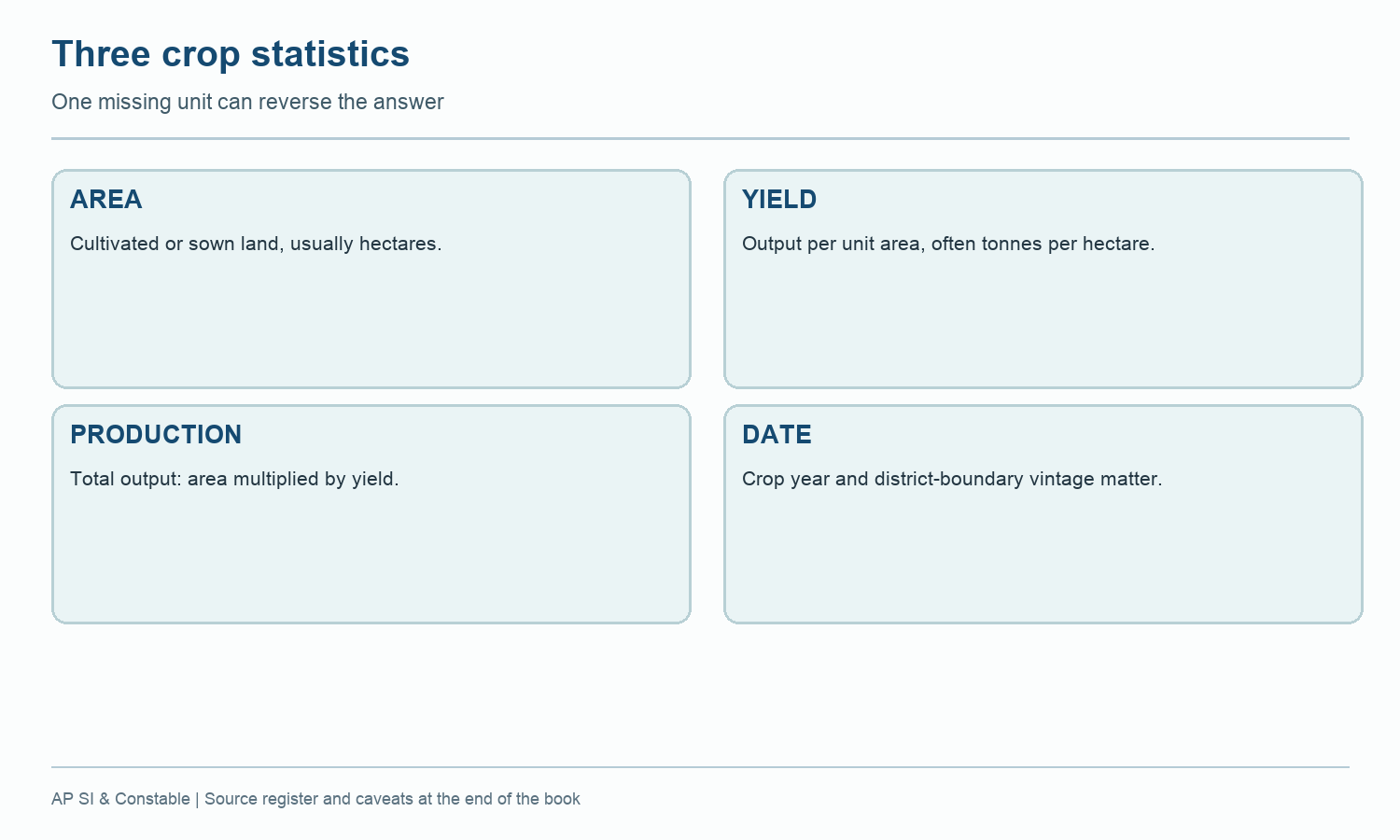
In current-affairs MCQs, distinguish area, production and yield. Area is the land planted; production is total output; yield is output per unit area. A district can have larger output because it has more area even if another district has higher yield. Procurement is a purchase and price operation after production; a crop-estimation survey is a statistical method to estimate output. Keep units on every number. This prevents a common wrong option that swaps lakh hectares and lakh tonnes.
Worked example: A harvested paddy crop moves through drying, milling and marketing before a consumer buys rice. A procurement price is not the same as a farmer's net income; transport, quality, moisture and input costs matter. The harvested grain quantity and milled rice quantity also differ. When an MCQ mentions 'rice production', check whether the source is reporting paddy or milled rice.
Active recall: Define area, production and yield in one sentence each. Where does milling sit in the chain?
Area, production and yield
Check hectare, tonne and per-hectare units before comparing districts.
Read this visual
Production equals area times yield only with consistent units and the same crop year and geography. Market arrivals are a different measure.
Current district geometry: APSDMA. Crop and irrigation claims: credited agriculture and water-authority sources.