A weightlifting event name usually contains a bodyweight category, while the result lists attempted lifts and total. The category can change across Olympic programmes, and the athlete's own category may change over time. It is a poor method to remember a single number and apply it to every year of an athlete's career. Ministry material identifies Malleswari's Sydney bronze in the 69 kg event; a separate 2012 press item appears to call it 63 kg, showing why the dedicated event source should control a class-specific question.
For AP Police preparation, the high-confidence core is person–weightlifting–Sydney 2000–bronze–first Indian woman Olympic medallist. This page illustrates a general examination skill: a source conflict should narrow the MCQ, not be hidden. Snatch and clean and jerk are the two lifts, whereas a medal is determined by the competition's final total and ranking. Do not call a world title an Olympic title merely because the same athlete achieved both.
Worked example: A weightlifting question supplies a class in kilograms. That number refers to a competition category, not the athlete's medal count or lifting total. Read the result sheet headings before copying numbers. Historical weight classes can change across editions, so match the class to Sydney 2000 rather than applying today's competition structure retrospectively.
Active recall: What is the stable Malleswari fact even when secondary pages disagree on a class number?
The scope of a first
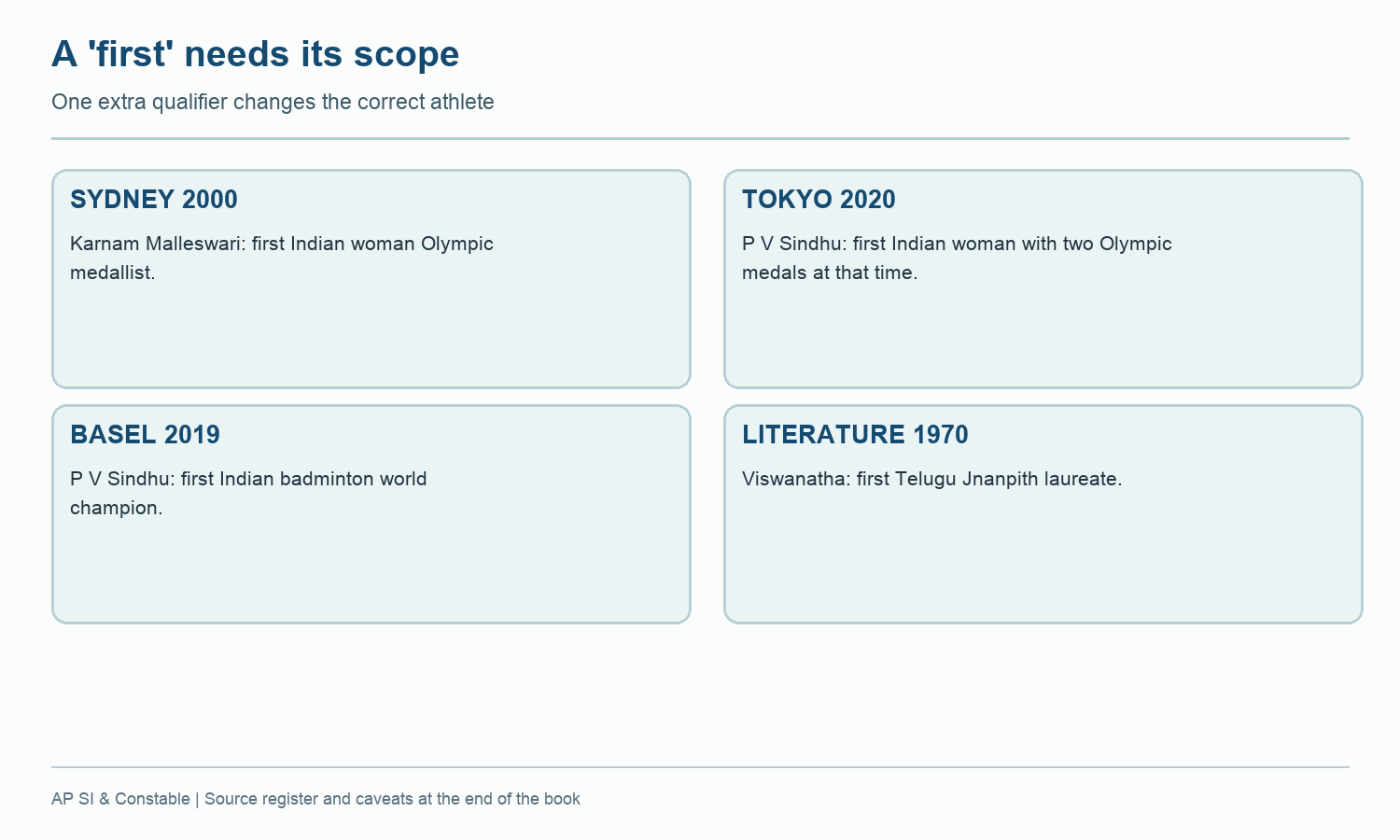
The category words distinguish Malleswari's and Sindhu's Olympic firsts.
Read this visual
A historical first depends on the full category. Malleswari was the first Indian woman Olympic medallist; Sindhu later became the first Indian woman with two Olympic medals.
Current district geometry: APSDMA. Sports results, awards and policy: credited issuing bodies.