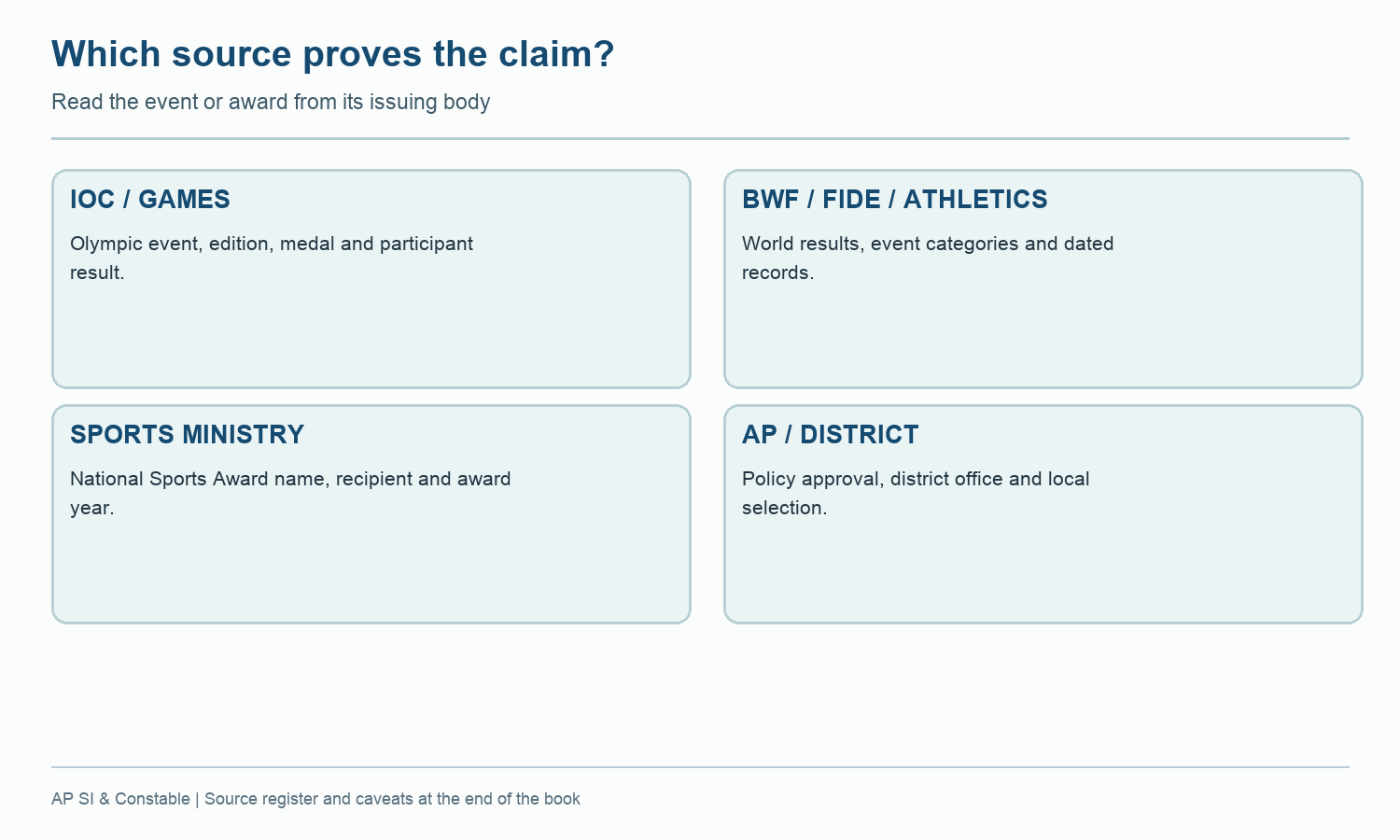
Read an international federation's event record for a championship result, the Olympic result book for an Olympic event, and the Ministry of Youth Affairs and Sports for the title and year of a National Sports Award. A state government order can establish a policy's adoption and intended measures; it does not prove that every planned facility has opened. District sports pages describe local administration, not an athlete's world ranking. This hierarchy keeps a promising policy sentence from becoming a false completed-achievement question.
Also check the date printed on the source. A ranking, national record or “youngest” superlative may be superseded. The year attached to Tokyo 2020 is the edition name although the Games were held in 2021. An award may be labelled 2023 and conferred at a ceremony in January 2024. These are compatible statements if their different time fields are named. The safest exam note records both rather than silently replacing one.
Worked example: A World Athletics profile gives an official event result, while an AP policy order gives a state programme and a district page gives an office. If a coaching note uses one source to assert all three, split the claims. For a current rank or record, use the federation's dated database. For an award year, use the issuing ministry's final list.
Active recall: Which source would you open for a Khel Ratna award year, an Olympic medal and a current hurdles record?
Which source proves which claim?
Read event, award, policy and district-office claims from their own issuing bodies.
Read this visual
Use the issuing body for each claim: federation for event result, ministry for award, state order for policy and district portal for office.
Current district geometry: APSDMA. Sports results, awards and policy: credited issuing bodies.