Chess results are organised by time control and format. Classical, rapid and blitz allow different amounts of thinking time; a player's ranking can differ in each. The Chess Olympiad is a national-team competition whose medals are not identical to a solo world championship crown. FIDE's player profiles display multiple ratings, so copying the first number into a general “world rank” statement can attach the wrong clock and date.
An exam may ask why Humpy's World Rapid gold does not prove a classical world title. The answer is the championship category. A team bronze for India at an Olympiad belongs to the team result, even if an individual player contributed on a board. Write cards in the form “person–format–event–year–medal/title.” This is the chess equivalent of distinguishing badminton singles from doubles. Both subjects reward careful reading more than memorising a long list of changing ranks.
Worked example: A chess score report says a player was a grandmaster and later won an Olympiad medal. Grandmaster is a title; Olympiad is a team tournament; classical, rapid and blitz describe time controls. Sort the nouns before assigning a result. A rapid gold cannot be relabelled classical simply because both events use the word 'world'.
Active recall: Classify a GM title, a rapid world gold and an Olympiad team medal as three different facts.
Chess title and time controls
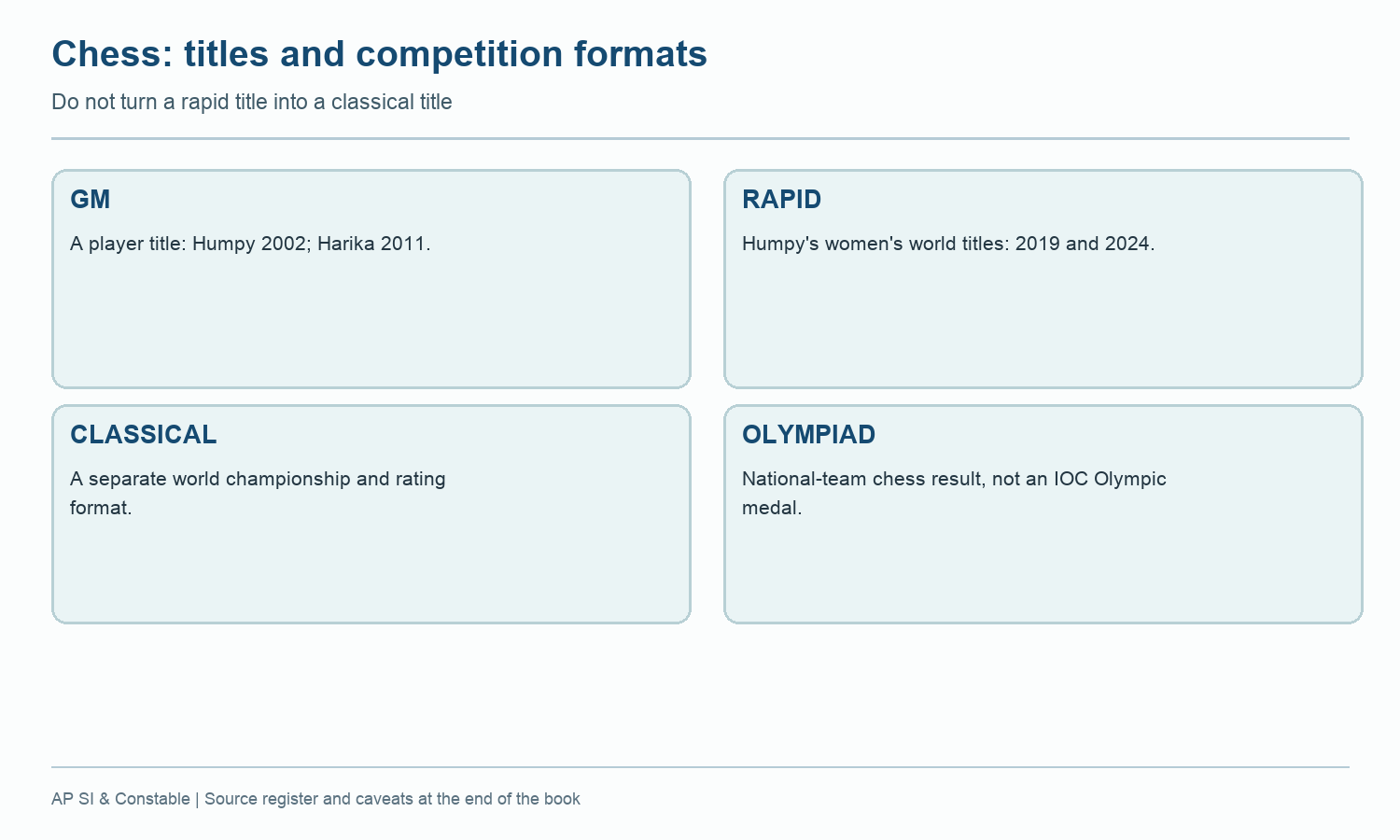
GM is a title; rapid and classical championships are distinct.
Read this visual
Grandmaster is a FIDE title. Rapid, classical and blitz describe different time controls; an Olympiad is a team event.
Current district geometry: APSDMA. Sports results, awards and policy: credited issuing bodies.