A dam impounds water; a reservoir is the stored water body; a barrage uses gates to raise and regulate a river level, often for diversion; an anicut is a lower diversion structure; a regulator controls flow entering a canal or branch. Names in historical records are not perfectly uniform, but the functional distinction helps with MCQs.
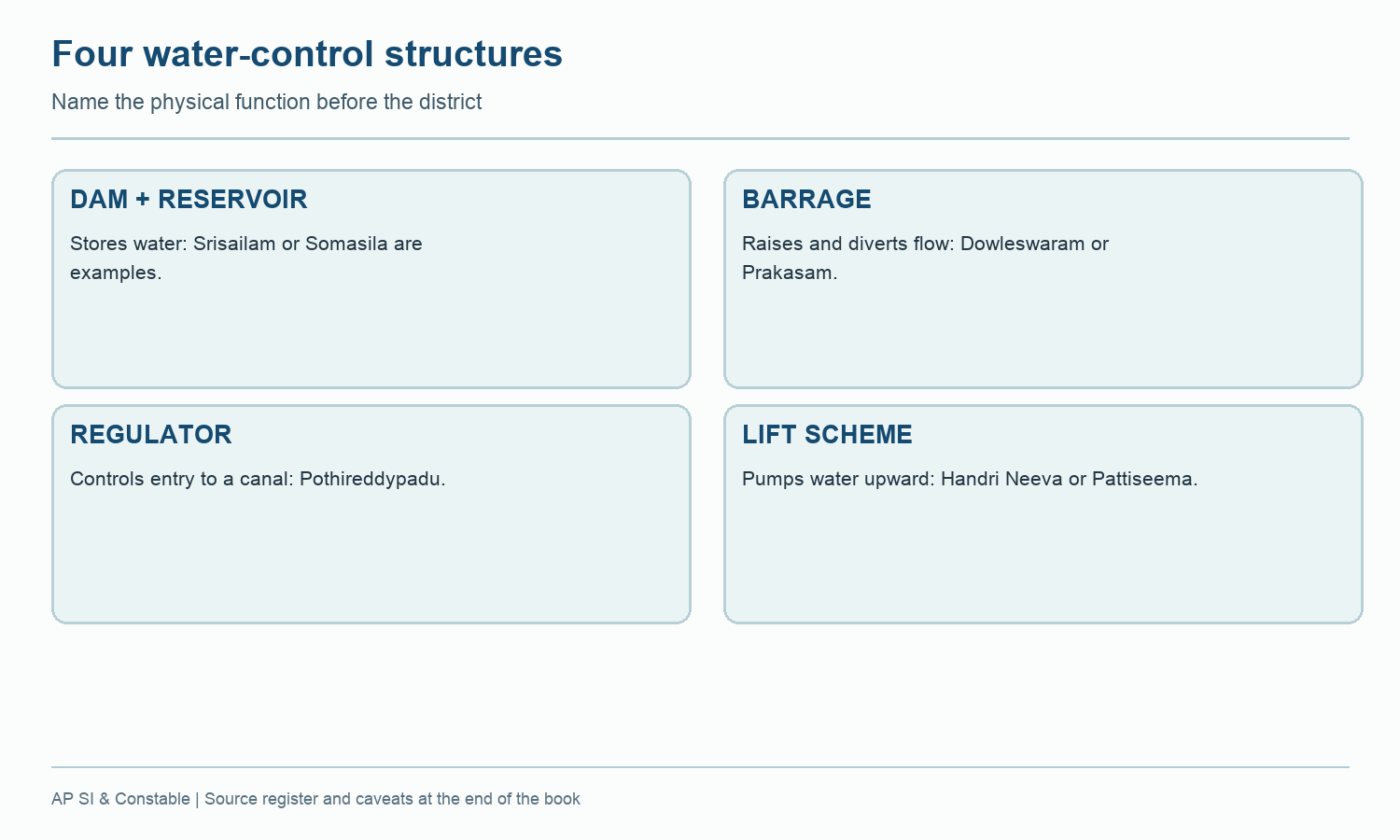
Dowleswaram and Prakasam are barrage anchors. Pothireddypadu is a head regulator. Srisailam and Somasila are storage reservoir anchors. Use the physical function before memorising the engineering label printed on a map.
Worked example: A dam usually impounds a substantial reservoir; a barrage raises and diverts river flow; a head regulator controls canal entry; an anicut is a diversion structure often used historically. These definitions overlap at the edges, so look at the purpose in the official project description. Srisailam is the storage example and Prakasam the barrage example. A visual with a water gate alone cannot establish the structure type.
Active recall: Locate the named river or project on the relevant map, name its function, and state which facts need a dated source.
Structure comparison plate
Dam, barrage, regulator and lift differ in function.
Read this visual
Compare storage, diversion, canal control and pumping functions. Classify a named structure by its actual function before matching it with a river or district.
District geometry: APSDMA. River layer: APSAC. Project and status details: credited water-resource agencies.